• Learn to Let Go
  • Books for Everyone
  • Work
  • newsletter
  • Journal
  • Shop
  • About
Menu

Meera Lee Patel

ARTIST, WRITER, BOOK MAKER
  • Learn to Let Go
  • Books for Everyone
  • Work
  • newsletter
  • Journal
  • Shop
  • About

Dear Somebody: The anchors we carry.

January 17, 2025

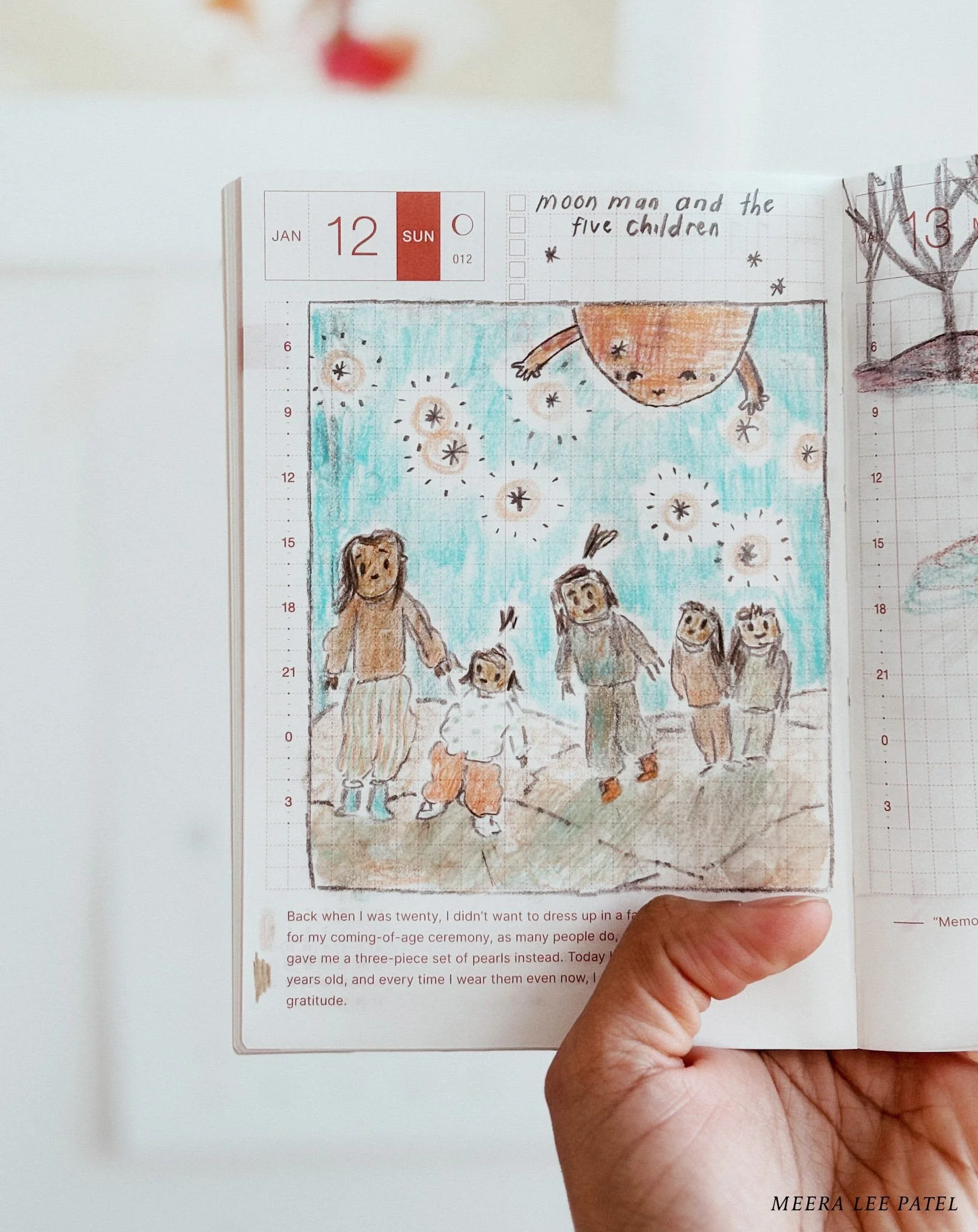
Moon Man and the five children (sketchbook, 2025)

A year from now, here are five things from this week that I'd like to remember:

MONDAY 

For the second time since N was born, I board a plane and travel with my children alone. We embark on a surprise trip to my sister’s, and none of us can wait. For N, it’s her cousins and all of the treats she doesn’t receive at home—but mostly, it’s her cousins. For F, it’s her cousins and the acrobatics—three flights of stairs to climb up and down on—but mostly, it’s her cousins. For me, it’s all of it: me and my sister and our five children, all corralled under one roof, a tangle of limbs and tears and, of course, indoor hide-and-seek.

Now and then, it pokes at me that the places most comforting to me are the ones where I’ve spent my formative years: by the water, on the east coast, near my sibling. Will I always turn towards the anchors of my childhood? Will I always feel the tug, known deeply by younger siblings—of reaching, wanting more? Of forever feeling two steps behind? 

The thoughts tumble in my mind while I stand at the kitchen island, watching my nephews play Madden on the living room floor. The oldest offers to teach me, but I love him too much to disappoint him by actually playing. N and Z are in the playroom, concocting meals out of pretend ingredients. They feed their dollies, they feed each other. They yell to see if anyone else is hungry; we all yell back that we aren’t. Only F feels out of sorts, clinging to my legs, wailing for something she doesn’t have the language to express. My sister scoops her up and carries her outside.

I smell the snow before I sense it, before I see the soft clumps accumulate on the back steps. The kitchen window isn’t cracked but the sharp, dampened scent of winter leaks in anyhow. I’m going to watch the snow, I announce. No one responds. 

In my sister’s arms, F is quiet. She’s listening to the snow, or maybe it’s very arrival is the world’s simple way of listening to her. Such is the strength of a young child’s heart. 

One by one, the rest of our band files onto the porch: first Z, who wants to see; then N, who wonders what Z is up to; then both boys, curious as to where everyone went. For this moment, Madden is on pause. 

The snowdrifts sort my thoughts and I know what I know: I don’t have an affinity for New Jersey or the east coast—or any particular nostalgia for the past. The only anchor I carry from childhood is my sibling, an anchor I’ll carry from house to house, shore to shore.

Our five children are cousins: together and sweet. The snow is the snow: always a pleasure. And I, so far removed from the roof, roads, and city that I call my own, feel perfectly at home. 

TUESDAY

“There’s one ceramic piece, by my daughter — my wife and I are super sad that we lost that. It’s an image of her as a 12-year-old holding a globe with the world on fire on top of her head. And it’s her in her overalls with her striped shirt on and brown hair. It’s an interpretation of an image I made after the fires in Malibu. She was becoming this awesome artist, interpreting the world through her art just like I do. To me it was an image of uncontrollable powerlessness — that feeling you know everyone shares, but through a kid’s eyes. My daughter’s sculpture was a symbol of someone becoming who they are in a moment of time we’ll never get back to.” —Cleon Peterson on what they grabbed.

I found these resources for LA from Nicole Cardoza’s Reimagined to be really helpful. Included are links to help organize, volunteer, and donate to aid those impacted by the wildfires. 

WEDNESDAY
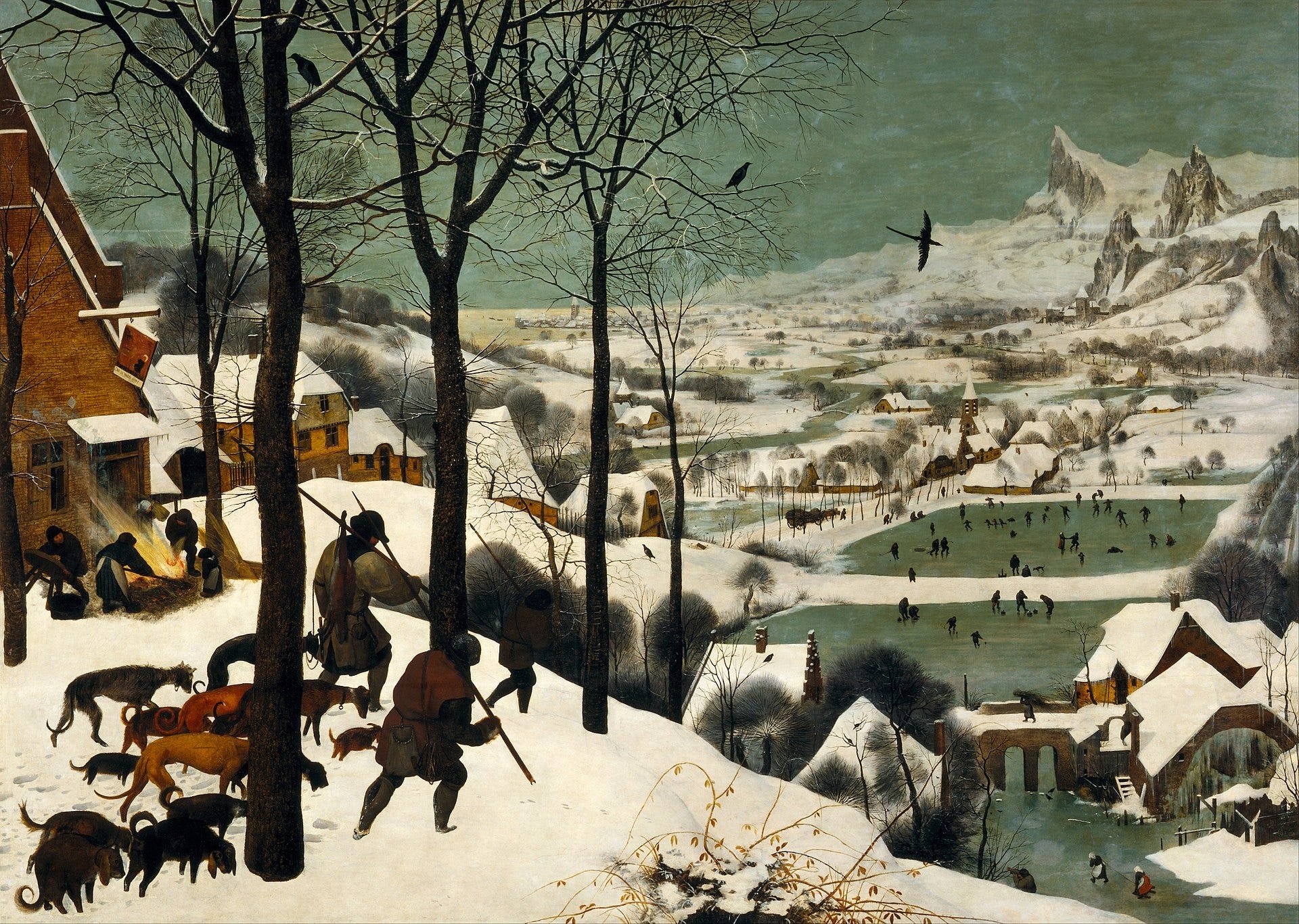
The Hunters in the Snow, 1565, oil on wood
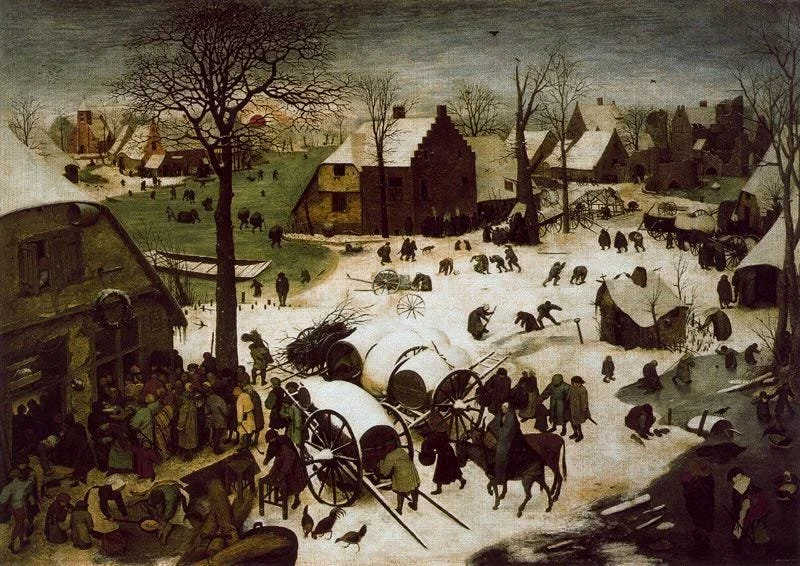
The Census at Bethlehem (1566), oil on wood panel

These world landscapes by painter Pieter Bruegel which simultaneously evoke in me a sense of war and peace, storm and calm, winter and the first day of spring. 

THURSDAY

“Consciousness lives on. The body is like a car, and the driver is the spirit, the bit of consciousness, the atom, the soul, you could say. And so the car gets old and rusted and falls apart and the driver gets out and continues on.” —David Lynch, rest in peace.

“Ideas are like fish. If you want to catch little fish, you can stay in the shallow water. But if you want to catch the big fish, you’ve got to go deeper. Down deep, the fish are more powerful and more pure. They’re huge and abstract. And they’re very beautiful.

The beautiful thing is that when you catch one fish that you love, even if it’s a little fish—a fragment of an idea—that fish will draw in other fish, and they’ll hook onto it. Then you’re on your way. Soon there are more and more and more fragments, and the whole thing emerges. But it starts with desire.”

—from Catching the Big Fish: Meditation, Consciousness, and Creativity by David Lynch

FRIDAY

So after weeks of rain
at night the winter stars
that much farther in heaven
without our having seen them
in far light are still forming
the heavy elements
that when the stars are gone
fly up as dust finer
by many times than a hair
and recognize each other
in the dark traveling
at great speed and becoming
our bodies in our time
looking up after rain
in the cold night together

—January by W. S. Merwin

See you next week!

xx,

M


To sign up for my weekly newsletter, Dear Somebody, please subscribe here.

In Sketchbook, Life Tags Traveling, Parenting, Parenthood, snow, Family, Nicole Cardoza, Cleon Peterson, Pieter Bruegel, David Lynch, W. S. Merwin
Comment

Dear Somebody: For the love of sisters

June 30, 2023

A year from now, here are five things from this week that I'd like to remember:

MONDAY 

I was able to speak with the wonderful Margo Tantau on her podcast Windowsill Chatsabout building a life of creativity and purpose. We also discuss living according to your values, being dedicated to your vision, and what I believe most holds us creatives back from success. You can listen to Episode 146 here. 

TUESDAY

My sister and her family visit for a couple days, a trip that comes and goes so quickly that it feels like a blur even while it’s happening. In tow are my two beautiful nephews and my niece, Z, who was born only a handful of weeks before N. The two girls are as different in personality and behavior as they are close in age: where N is cautious and meditative, Z is adventurous and impulsive. Together, though, there is some semblance of balance. 

Different doesn’t always attract. It was more than two decades before my sister and I discovered our own rhythm, mashed somewhere between college graduations, first apartments, and marriages. Each time I reached a life milestone she’d already passed through it brought us closer together. For awhile, we’d swim in the same waters, and then she’d go on ahead again. 

Our personalities follow traditional birth order to a certain degree. As the older child, my sister tends to be a bit of a perfectionist while I enjoy making a good mess with my hands. She’s conscientious and thoughtful, quick to say the right thing and mean it; I have learned how to be less judgmental, more vulnerable. I am confrontational, she likes keeping the peace. We’re both cripplingly self-aware. 

We take the kids to the City Museum, the emerald city of St. Louis. Z bounces off the industrial bridges and steel-roped ladders, climbing as quick as her agile little body allows. N clings to her dad hard. She doesn’t want to climb, she doesn’t want to run, she doesn’t want to try—or she does, but not now. I encourage her, and then fight the urge to continue. How often have I wanted the very same thing my parents have wanted for me, simply in my own time? 

Z and her brothers are out of sight, lost somewhere in the noise of Sabreliner 40 aircrafts and frighteningly oversized slides. Slowly, N begins to open. She walks across a four-foot-wide Slinkie and peers through each square window. She watches. She avoids the vertical tunnels, opting instead for the narrow stairs, and climbs to the top of a castle turret. I ask her what she’s thinking, as I often do, but she doesn’t answer. She watches. Eventually, she lets her dad’s hand go and climbs a half-dome gym on her own. Slowly, I see her unfurl. She’s a lily, blooming—not hesitantly, but with deliberation, the way someone who knows herself well does. 

After awhile, we all meet up and herd the kids inside for lunch. There, surrounded by half-eaten pretzels and hot dogs, ice cream cups and toddler water bottles, N and Z begin to run. They run back and forth across the 1870’s Vault Room, chasing each other with open arms. Z speeds across and N helps her up when she falls. N laughs hysterically, falling on purpose, and Z puts out her hand for the assist. They smile and hug, their faces full of childhood and joy. This is special, I think to myself, as I look at their eyes which are looking into each others’. 

I’ve spent my entire life counting the ways my sister and I are different, as if it matters, as if we’d allow the very things that make us who we are keep us apart. I know, with certainty, that this is driven by the fear that we one day will. 

I note this now, as I watch N and Z fall to the ground still hugging, still laughing, their arms braided together. At my age, it is obvious: the way sisters can fall apart if they’re not too careful, how all friendships—even those bound by blood—need nurturing, like young lilies waiting for bloom. 

To N and Z, it is far less complicated. As it should be. The afternoon sunlight streams through the second-story window. One child’s tiny hand prepares to reach out in anticipation, in knowing—before the other child falls. Slowly, my heart grounds itself. 

WEDNESDAY

On learning how to see in our creative work:

“I am astonished in my teaching to find how many poets are nearly blind to the physical world. They have ideas, memories, and feelings, but when they write their poems they often see them as similes. To break this habit, I have my students keep a journal in which they must write, very briefly, six things they have seen each day—not beautiful or remarkable things, just things. This seemingly simple task usually is hard for them. At the beginning, they typically "see" things in one of three ways: artistically, deliberately, or not at all. Those who see artistically instantly decorate their descriptions, turning them into something poetic: the winter trees immediately become "old men with snow on their shoulders," or the lake looks like a "giant eye." The ones who see deliberately go on and on describing a brass lamp by the bed with painful exactness. And the ones who see only what is forced on their attention: the grandmother in a bikini riding on a skateboard, or a bloody car wreck. But with practice, they begin to see carelessly and learn a kind of active passivity until after a month nearly all of them have learned to be available to seeing—and the physical world pours in. Their journals fill up with lovely things like, "the mirror with nothing reflected in it." This way of seeing is important, even vital to the poet, since it is crucial that a poet see when she or he is not looking—just as she must write when she is not writing. To write just because the poet wants to write is natural, but to learn to see is a blessing. The art of finding in poetry is the art of marrying the sacred to the world, the invisible to the human.” 

—The Art of Finding by Linda Gregg

THURSDAY

“This is the true joy in life, being used for a purpose recognized by yourself as a mighty one. Being a force of nature instead of a feverish, selfish little clod of ailments and grievances, complaining that the world will not devote itself to making you happy. I am of the opinion that my life belongs to the whole community and as long as I live, it is my privilege to do for it what I can. I want to be thoroughly used up when I die, for the harder I work, the more I live. I rejoice in life for its own sake. Life is no brief candle to me. It is a sort of splendid torch which I have got hold of for the moment and I want to make it burn as brightly as possible before handing it on to future generations.”

—George Bernard Shaw

FRIDAY

Old friend now there is no one alive
who remembers when you were young
it was high summer when I first saw you
in the blaze of day most of my life ago
with the dry grass whispering in your shade
and already you had lived through wars
and echoes of wars around your silence
through days of parting and seasons of absence
with the house emptying as the years went their way
until it was home to bats and swallows
and still when spring climbed toward summer
you opened once more the curled sleeping fingers
of newborn leaves as though nothing had happened
you and the seasons spoke the same language
and all these years I have looked through your limbs
to the river below and the roofs and the night
and you were the way I saw the world

—Elegy for a Walnut Tree by W. S. Merwin

xx,

M


To sign up for my weekly newsletter, Dear Somebody, please subscribe here.

In Life Tags Sisterhood, Sisters, Margo Tantau, Windowsill Chats, Family, Siblings, Cousins, Parenting, Parenthood, Motherhood, City Museum, St. Louis, Brothers, Creativity, Linda Gregg, The Art of Finding, George Bernard Shaw, Joy, W. S. Merwin, Elegy for a Walnut Tree
Comment

Meera Lee Patel is an artist, writer, and book maker. Her books have sold over one million copies, and been translated into over a dozen languages worldwide.

Her newsletter, Dear Somebody, is a short weekly note chronicling five things worth remembering, including a look into her process, reflections on motherhood, and creative inspiration.

Join thousands of other readers by subscribing.


Latest Posts

Featured
Apr 10, 2026
Dear Somebody: The hard work of it makes me shine.
Apr 10, 2026
Apr 10, 2026
Apr 3, 2026
Dear Somebody: A thousand years.
Apr 3, 2026
Apr 3, 2026
Mar 6, 2026
Dear Somebody: On giving up.
Mar 6, 2026
Mar 6, 2026
Feb 20, 2026
Dear Somebody: A monster inside the wall.
Feb 20, 2026
Feb 20, 2026
Jan 30, 2026
Dear Somebody: More Than Machine.
Jan 30, 2026
Jan 30, 2026

categories

  • Books 12
  • Life 62
  • Motherhood 11
  • Picture Book 1
  • Process 31
  • Sketchbook 12
  • Writing 4
Full archive
  • April 2026 2
  • March 2026 1
  • February 2026 1
  • January 2026 3
  • December 2025 1
  • November 2025 1
  • October 2025 4
  • September 2025 3
  • August 2025 1
  • July 2025 1
  • June 2025 3
  • May 2025 3
  • April 2025 4
  • March 2025 1
  • February 2025 2
  • January 2025 3
  • December 2024 2
  • November 2024 2
  • October 2024 2
  • September 2024 3
  • August 2024 2
  • July 2024 2
  • June 2024 2
  • May 2024 3
  • April 2024 2
  • March 2024 4
  • February 2024 4
  • January 2024 3
  • December 2023 2
  • November 2023 2
  • October 2023 4
  • September 2023 5
  • July 2023 2
  • June 2023 2
  • May 2023 3
  • April 2023 2
  • March 2023 4
  • February 2023 3
  • January 2023 4
  • December 2022 2
  • November 2022 1
  • August 2022 1
  • July 2022 2
  • May 2022 2
  • April 2022 2
  • March 2022 1
  • January 2021 1

READ MY BOOKS


Copyright © 2023 Meera Lee Patel