
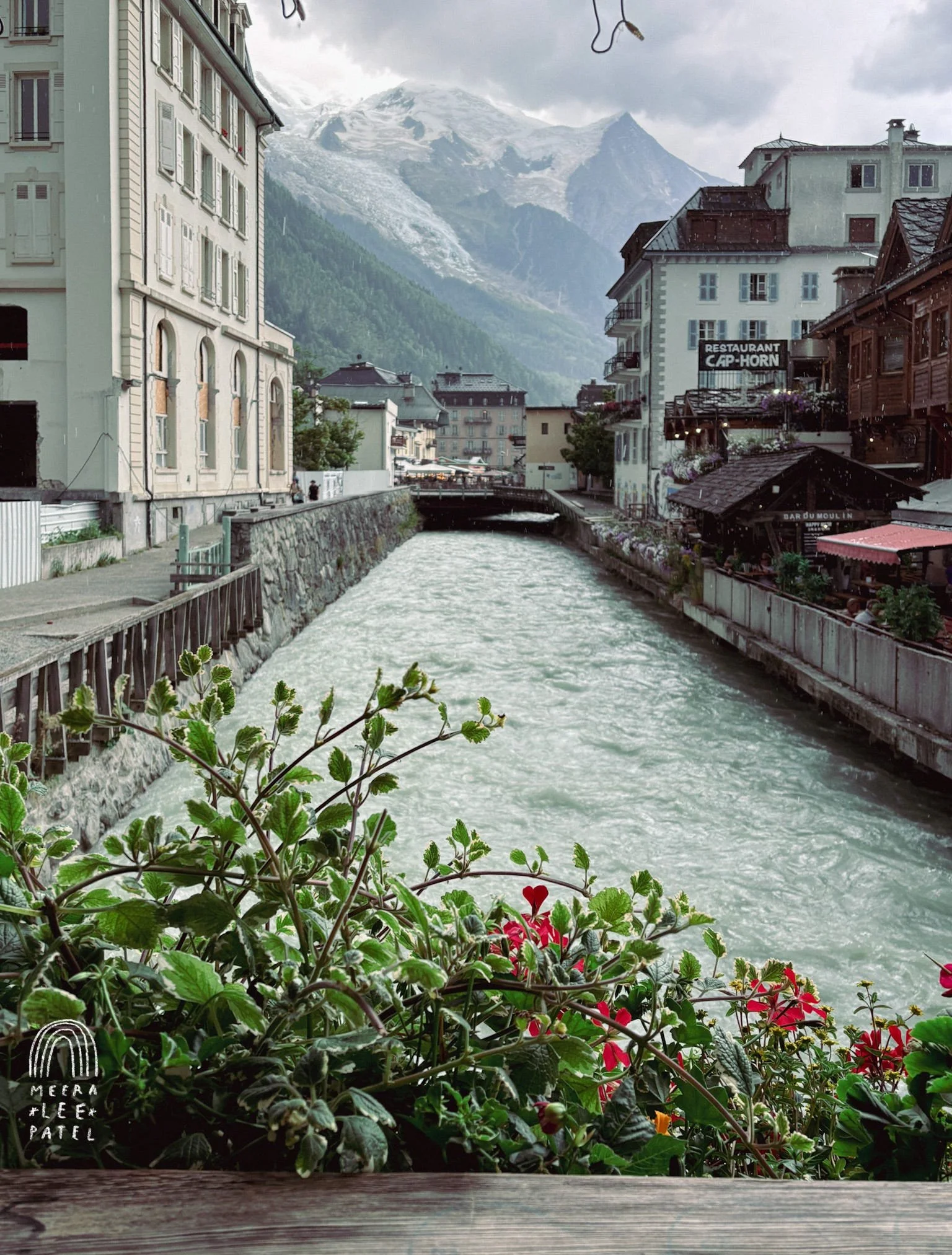
Observing Mont Blanc in Chamonix, France (2025)
A year from now, here are five things from this week that I'd like to remember:
MONDAY
As we approach Chamonix, I see Mont Blanc rising in the distance, rising up out of the ground as it once rose out of the sea. The only time I ever felt the word majestic come alive with meaning was in the Yamanashi Prefecture, when, after days, the clouds petered for a few minutes and let Mt. Fuji materialize before our eyes.
I felt awe then, as I do now.
Moon! F says, pointing at the sky, and we all look up. Dozens of moons sway in the sky, so tiny they look like colorful pinpricks in the clouds. They slowly drift closer, and as they do, we realize that each pinprick is a person falling from the sky.
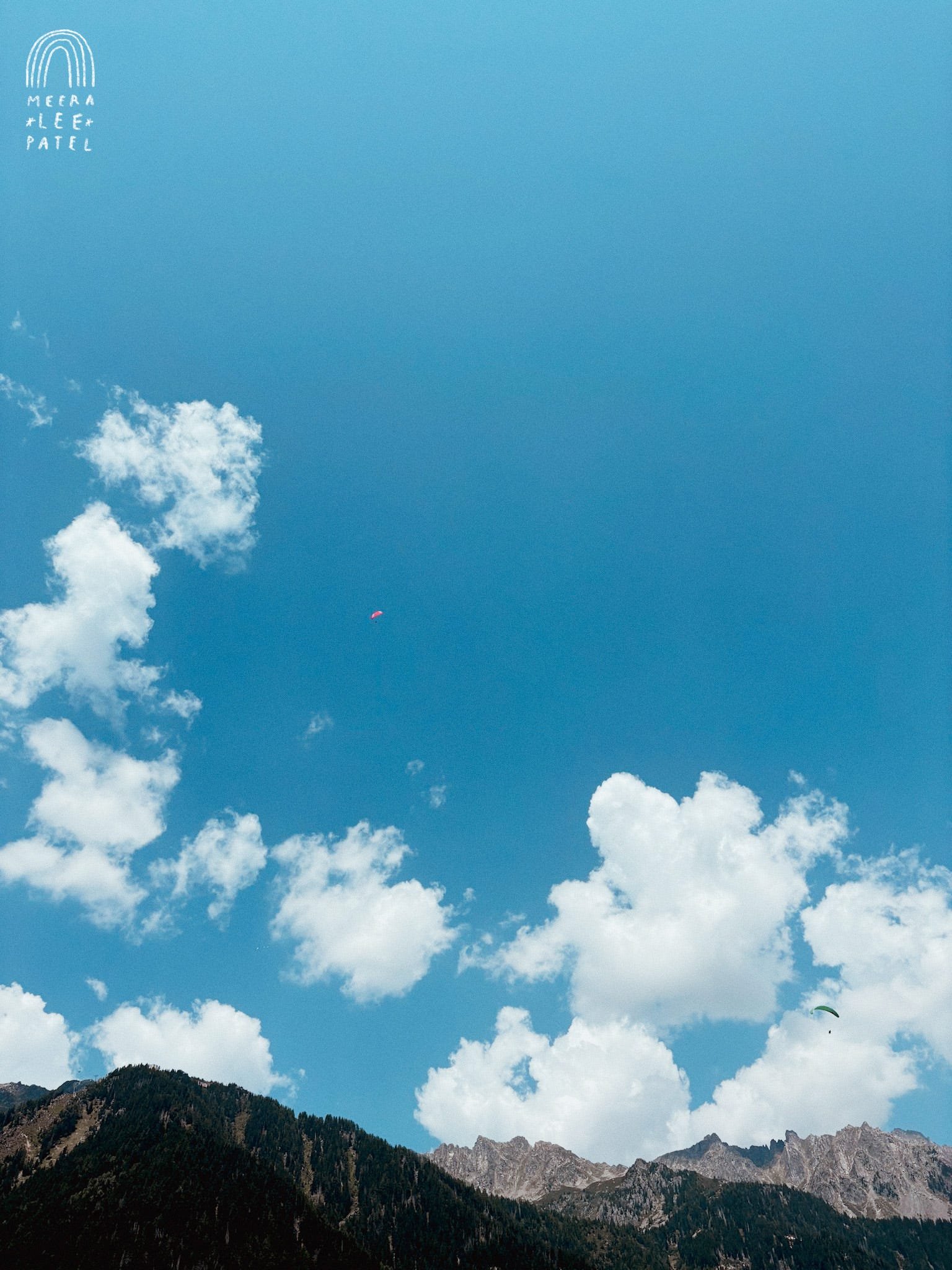
Falling from the sky in Chamonix, France (2025)
I’m going to do that, says T, watching each paraglider careen over mountains and pine trees. Some pirouette as they come towards earth, some swing back and forth, many simply glide. Each one is attached to their own pair of wings, in hues of bright yellows or pinks or reds. As the ground swells up before them, they quickly find their legs again, no longer able to rely on pockets of air to help them move.
Every time I look up, I see tiny pinpricks in the clouds: red, yellow, pink. Our eyes follow each person as they slowly come into view; we hold our breath until we see them land; we cheer as their feet touch the ground. Each flight is staggering, a feat of engineering that allows a person, who will never possess the splendor of a bird or a mountain, to momentarily gain wings.
All week, T talks about paragliding. He asks me to go with him, but I have little desire to fall from the sky. I have no interest in jumping off a cliff, or a plane, or a bridge. I like being on the ground. By the end of the week, it becomes evident that no one else is up for the risk, either. The only person adventurous enough to accompany T is N, who, at four years old, simply isn’t allowed. When I’m five, I’m going to fall out of the sky, too, she stubbornly vows. Like dad.
Two days before we leave France, I tell T I’ll join him. I know we simply can’t go home without him having flown. I make peace with knowing that for my wings to take flight, I’ll first have to fall.
In the morning, I feel calm—detached, even, but as our gondola begins the steep incline up Mont Blanc, the familiar rush of anxiety washes over me. We climb higher and higher. After a few minutes, I stop looking down. At the foot of Aiguille du Midi, I’m 8,000 feet above ground. My gliding instructor, Luciolle, is serious and kind. He asks me what my name is.
OK, Meera, he says. When I tell you to run, you run quickly, with strength. You run until you run off the mountain. Don’t slow down. Don’t stop running. Can you do that?
Yes, I say. I can do that.
Luciolle clips me into the harness, and then clips himself in behind. He untangles our wings and makes sure our wires aren’t crossed. He checks that the impending storm brewing in the clouds isn’t heading our way. Then: he tells me to run.
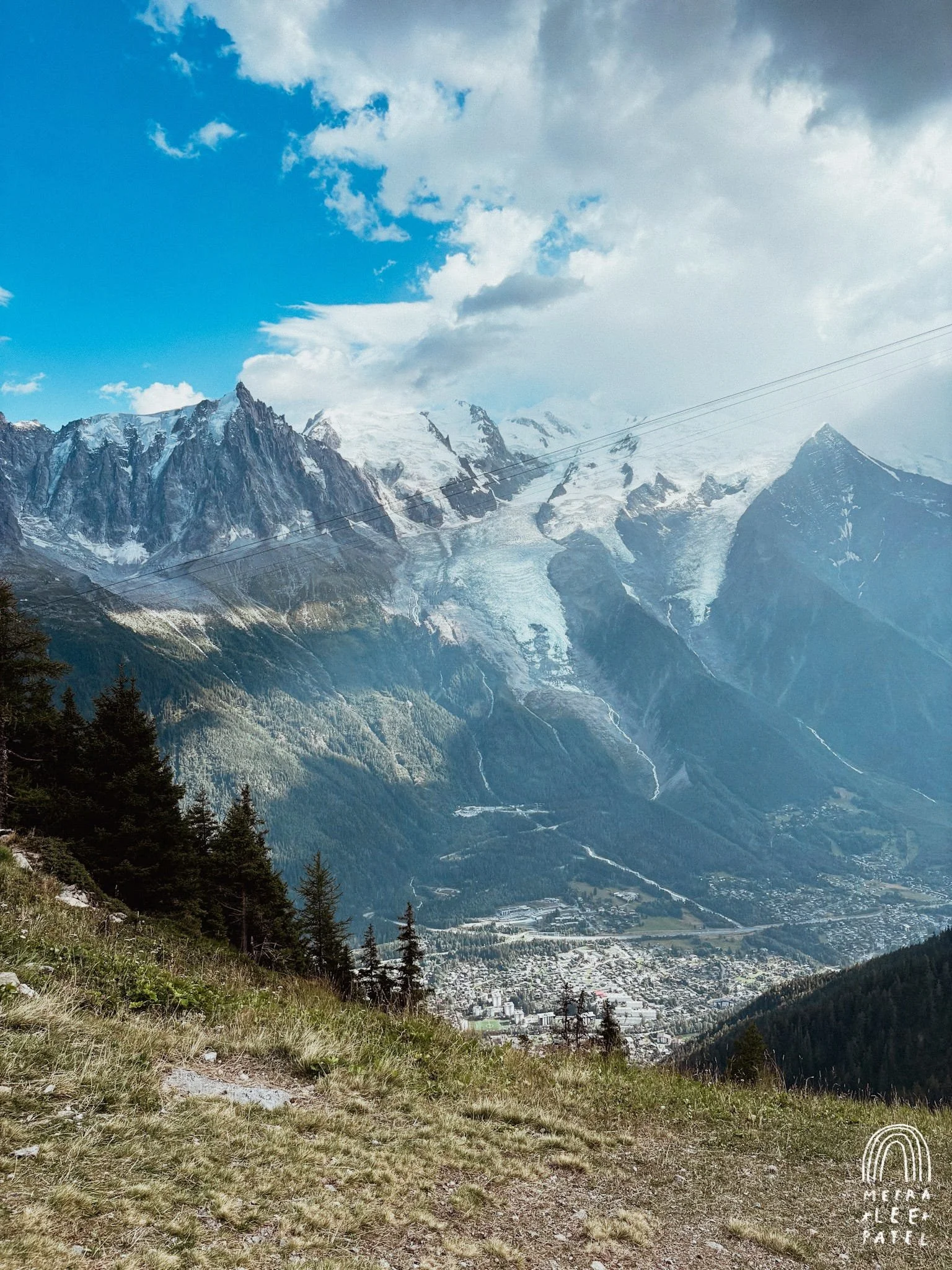
The foot of Aiguille du Midi, Chamonix, France (2025)
I turned my brain off in preparation for this moment, so when I hear his shout in my ear, I don’t hesitate or think or ask questions. I just run, really fast. I run off the edge of the mountain.
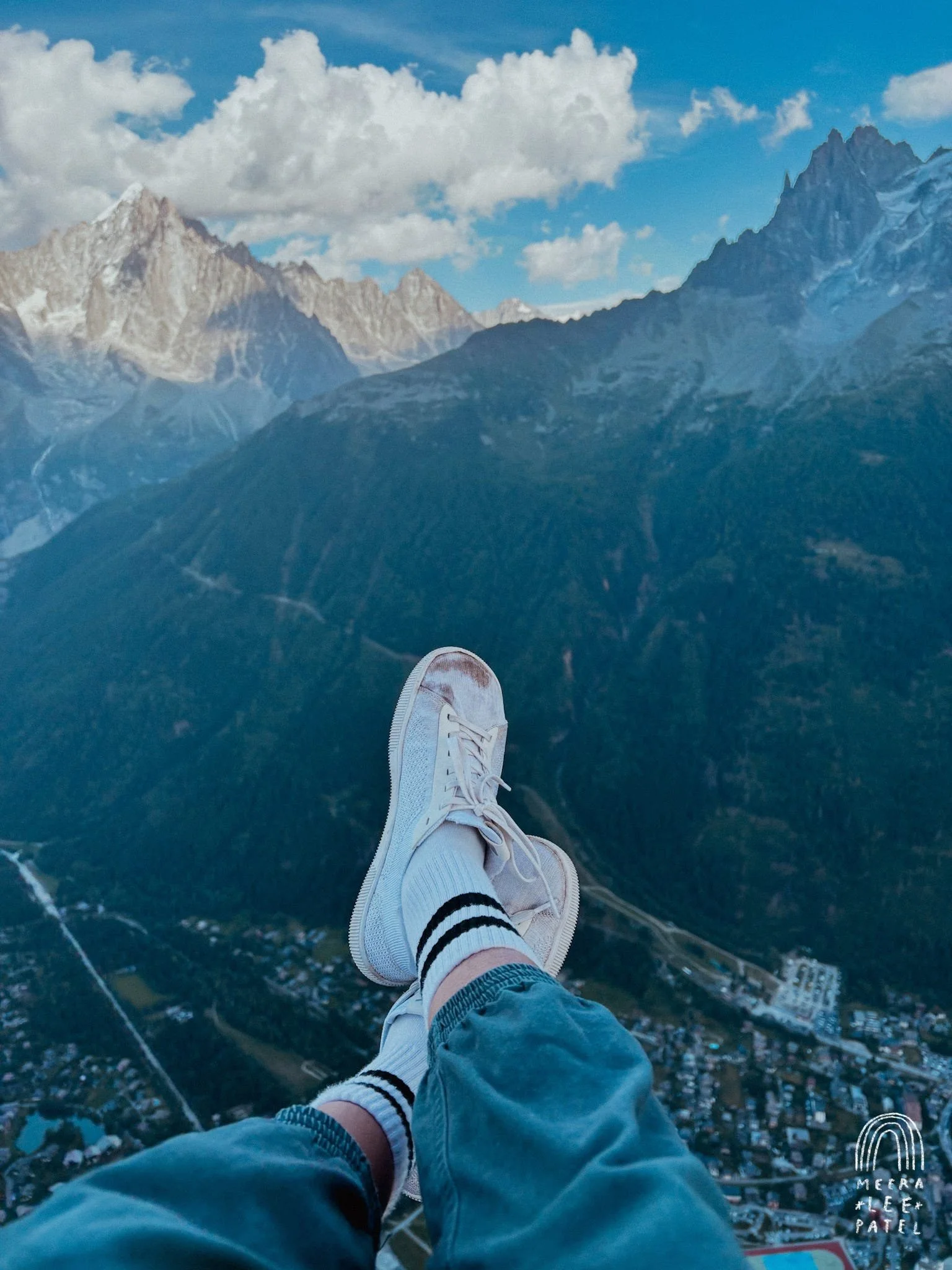
Suspended 9,000 feet in the air in Chamonix, France (2025)
Suspended 8,000 feet in the air, I try not to let the anxiety in my stomach turn into nausea. We catch thermals and climb higher, to 9,000 feet, and then higher still. I tell myself I’m a bird, and I am. I tell myself to breathe slowly and I do. Luciolle teaches me to steer, and I take us over a sea of pine trees, emerald crayon marks against a bright sky. If I go east, I’ll head towards the storm, and if I go west, I’ll scale Mont Blanc, the crest of its face covered in glittering show. At 10,000 feet in the air, I make choices I never dreamed I’d have.
The air is cool against my face. Up this high, the world is quiet, and calm, and sweet. I feel the silence of everything; freedom from thought. It’s my one chance to fly—to do what man isn’t supposed to do—and I do.
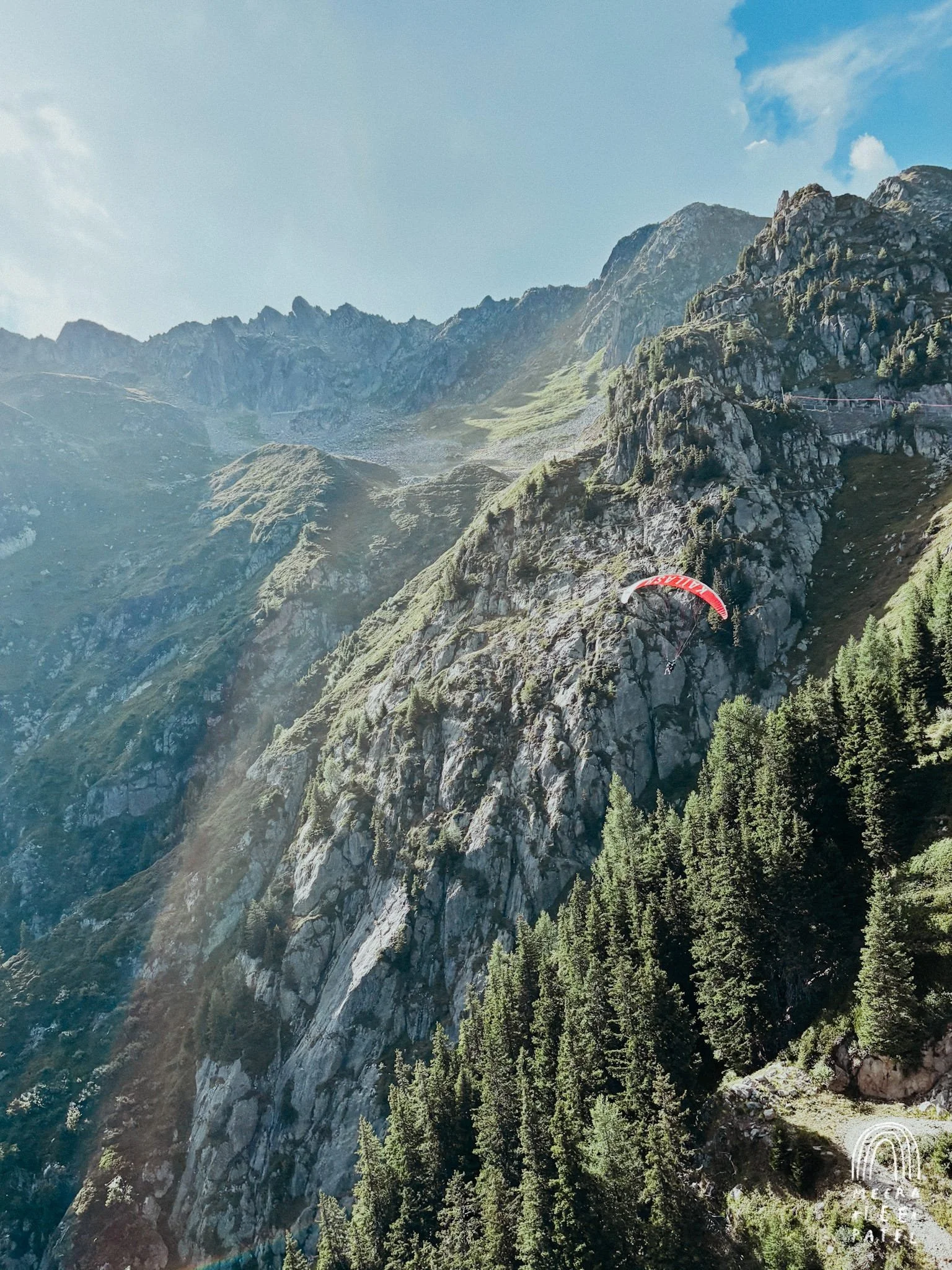
T jumps into flight in Chamonix, France (2025)
Even now, weeks later, I’m not certain of why I decided to fly. All I know is that my desire for T to get his wish is greater than my desire to keep my feet on the ground. I recognize that the thrill, for me, isn’t in becoming a bird or in surprising myself by doing something I’d never imagined I’d do. It isn’t even in the joy of seeing my small children run to me upon landing, their sweet faces split into wide grins. For me, the thrill is in seeing T get his wish—in knowing that because of our companionship, a person I love won’t later feel regret.
I joke about it now—how I begrudgingly ran off a cliff for a person I love. But I know that every now and then, in order to become the person I wish to be, I, too, will need a gentle prod—or maybe, a pair of wings.
TUESDAY
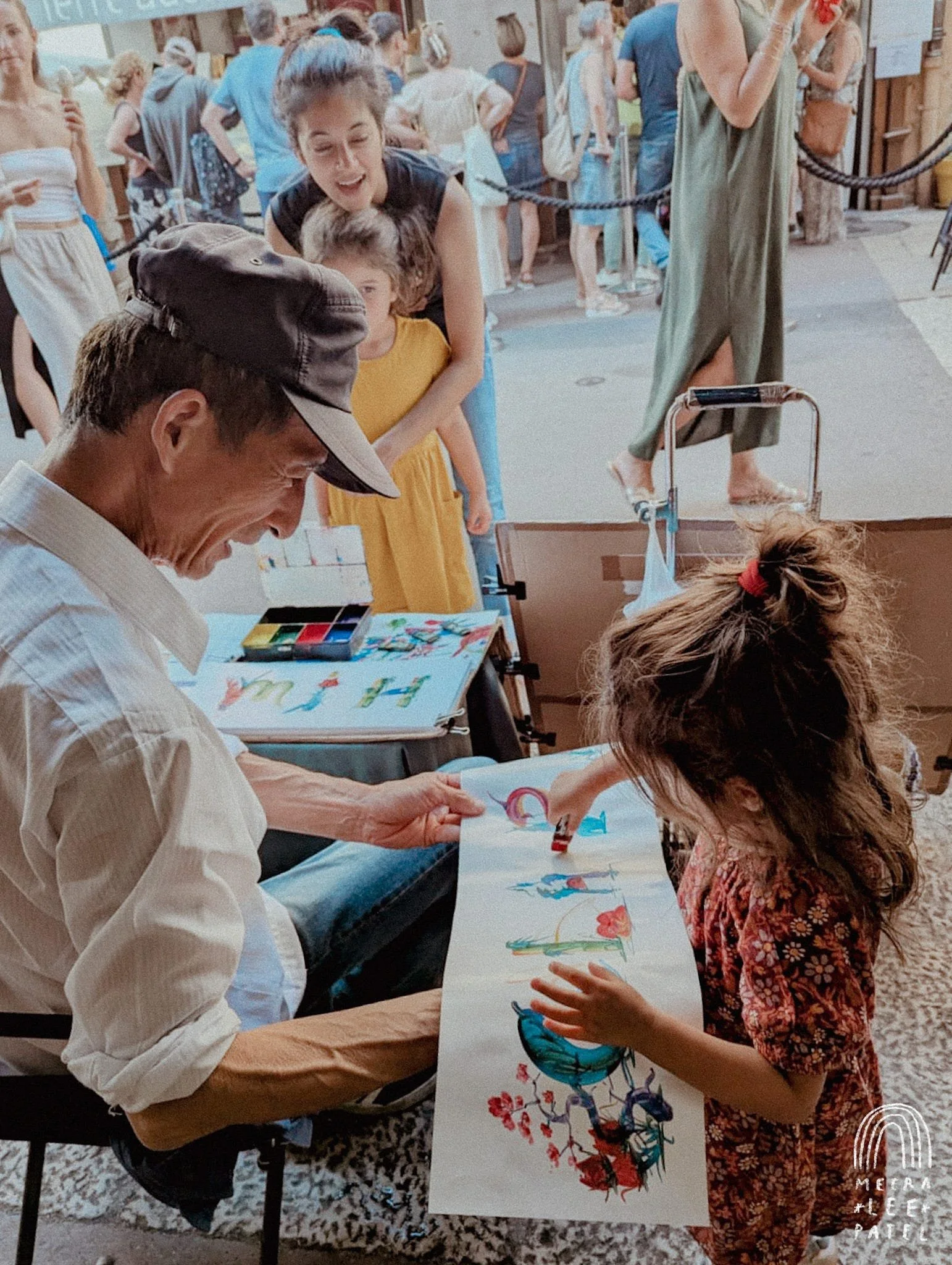
The portrait of a young artist in Annecy, France (2025)
Lake Annecy is stunning—so turquoise and clear that it’s easy, for a moment, to believe it won’t always be this way. Dozens of summering families mill about, sunbathing or sleeping or wading out into the water. For once, summer feels easy—like the simple glories provided by the earth are finally enough.
As is her way, F makes friends with a local street artist who invites her to paint with him. As we leave, he gifts her their collaboration, which now hangs proudly in her room.
WEDNESDAY
I promise myself I’ll work in my sketchbook while traveling, and though I did here and there, I mostly take notes and photos, save scraps, and make scribbles to revisit later.
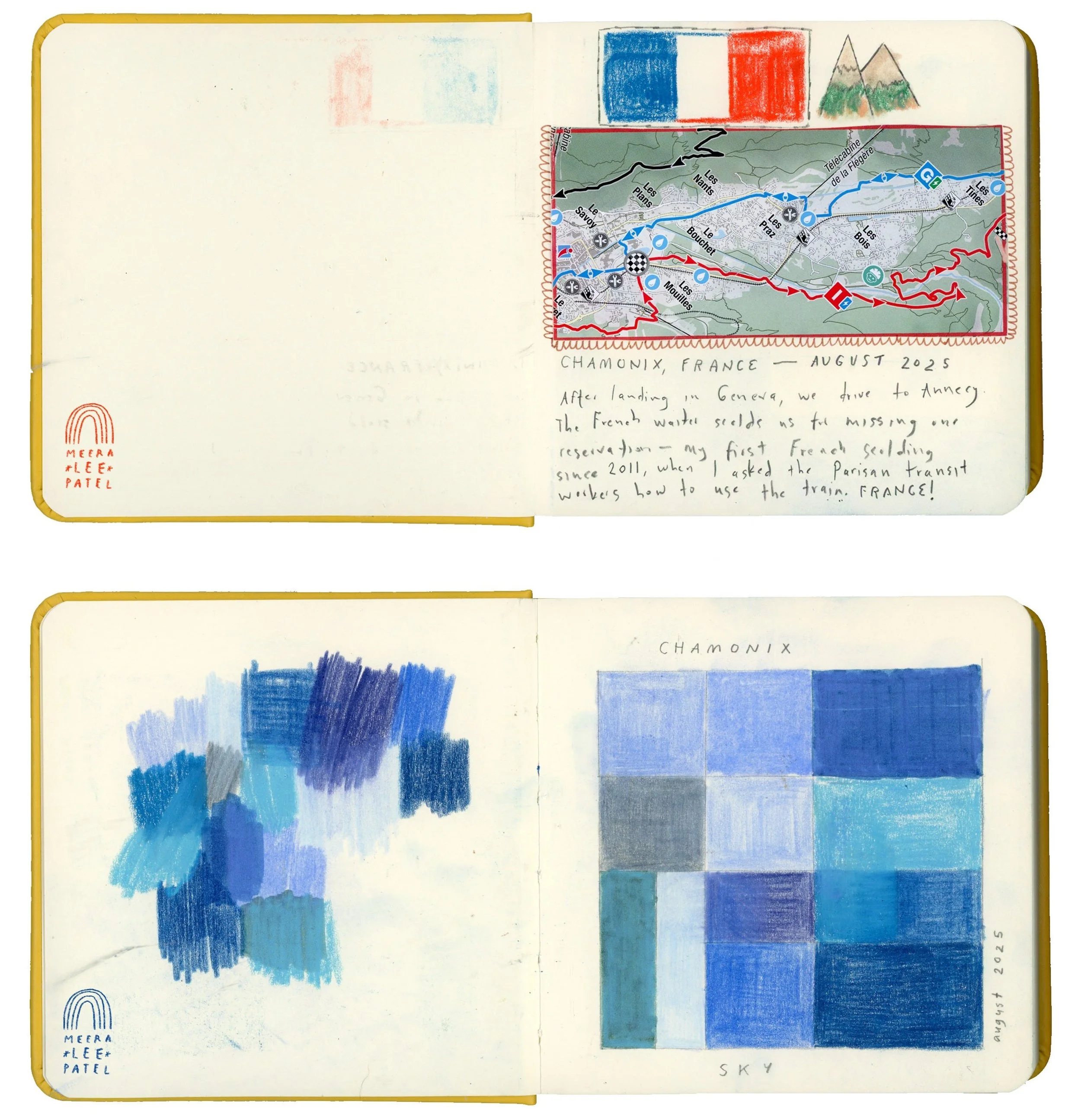
France sketchbook (2025, colored pencil and marker on paper)
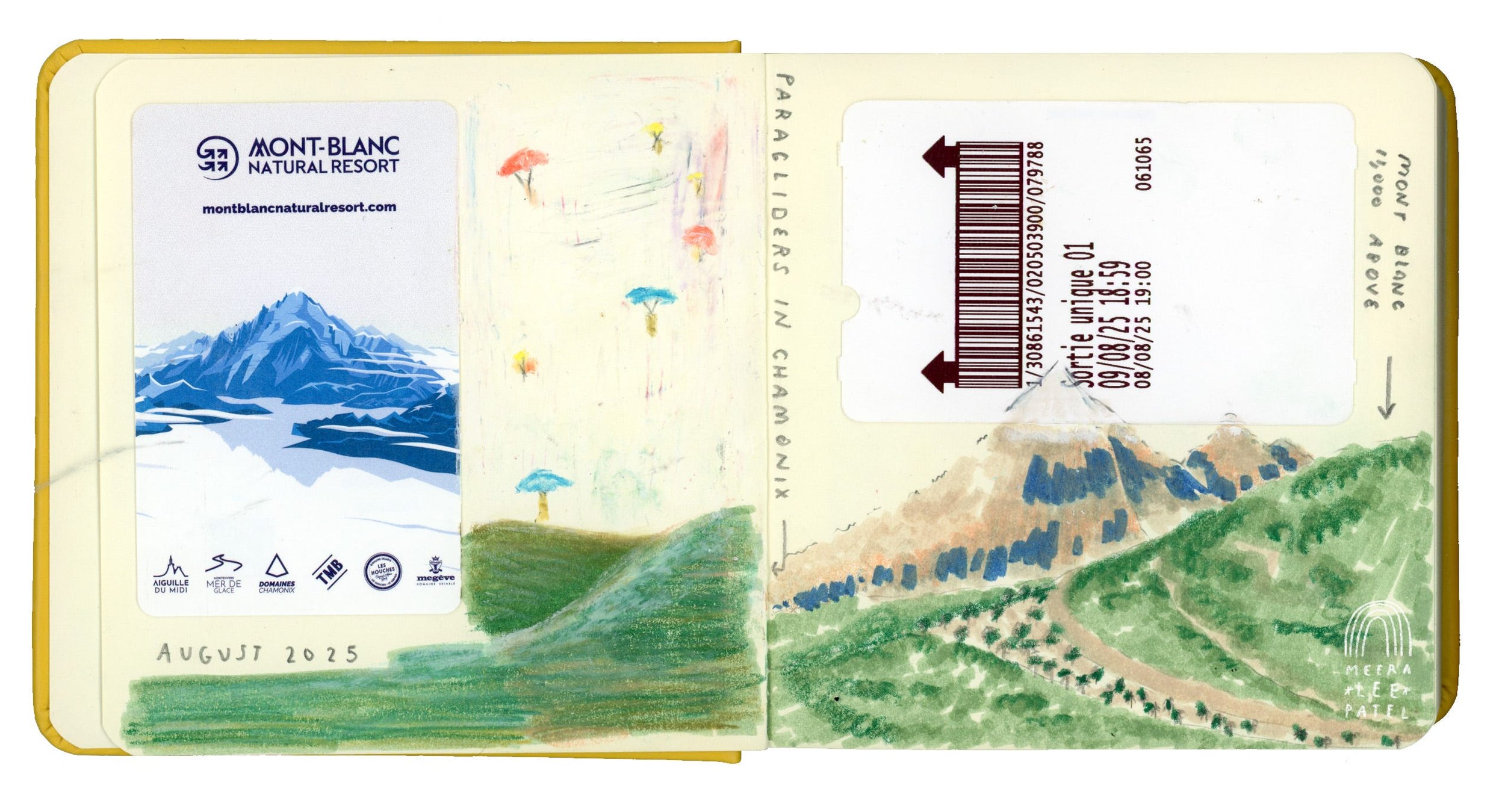
France sketchbook (2025, crayon and marker on paper)
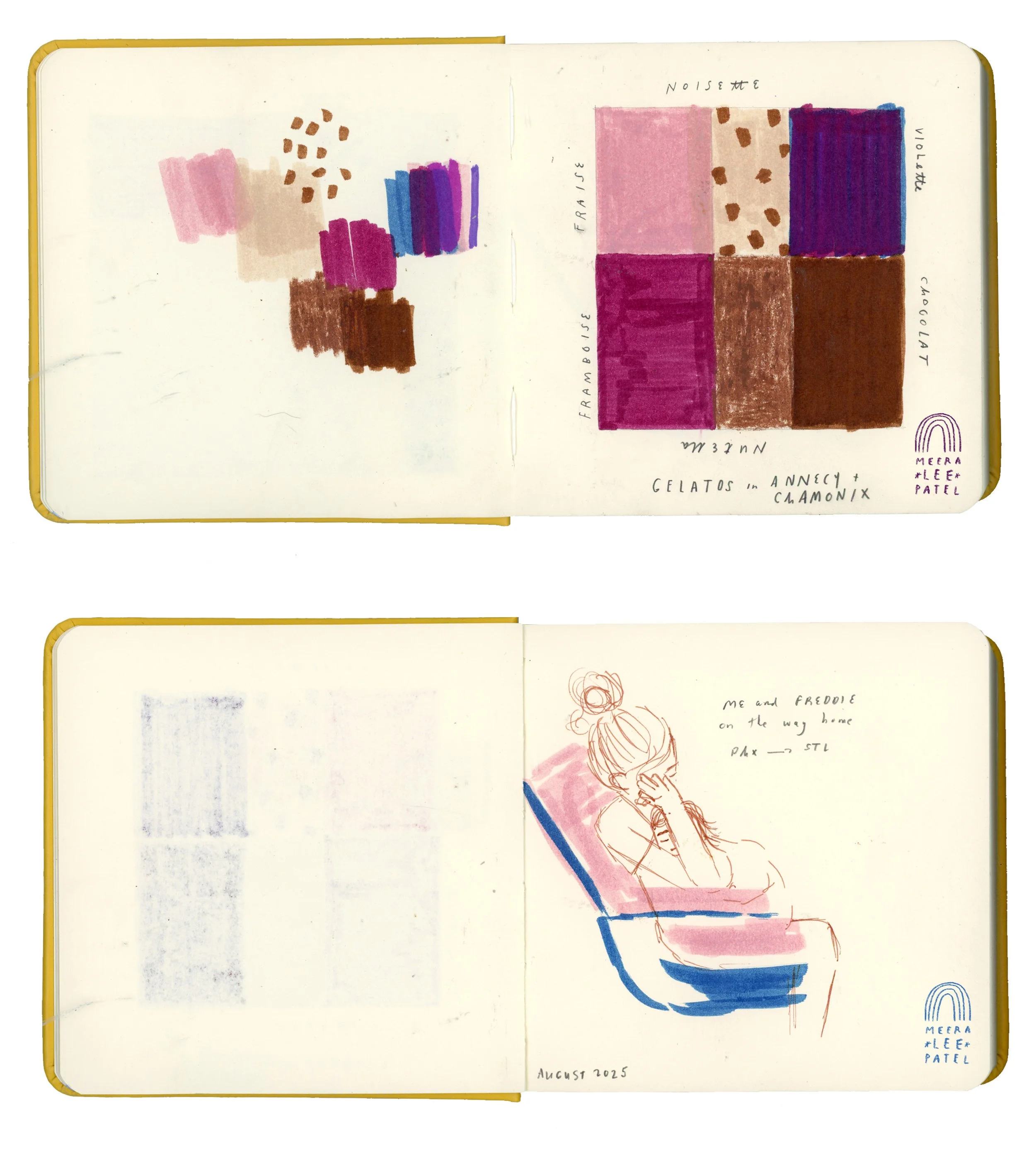
France sketchbook (2025, crayon and marker on paper)
I find that I work in my sketchbook more when I give myself a break: get to it when I can, make peace with the drawing that appears, and demand less of myself when I’m in the present moment—other than simply being there.
THURSDAY
“Imagine the places you grew up, the places you studied, places that belonged to your people, burned. But I should stop pretending that I know you. Perhaps you do not have to imagine. Perhaps your library, too, went up in smoke.
You must understand: There is no single day on which a war begins. The conflict will collect around you gradually, the way carrion birds assemble around the vulnerable, until there are so many predators that the object of their hunger is not even visible. You will not even be able to see yourself in the gathering crowd of those who would kill you.” —from V. V. Ganeshananthan’s Brotherless Night
I listen to Brotherless Night, which is set during the Sri Lankan civil war, over the course of a week. Each time I stop to tend to the realities of my life, I find myself unable to stop considering the reality of a life—and a family, splintered by war. There is nothing I didn’t love about this book, but Nirmala Rajasingam’s eloquent, perfectly-paced narration makes listening to it an absolute pleasure.
FRIDAY
By the first of August
the invisible beetles began
to snore and the grass was
as tough as hemp and was
no color—no more than
the sand was a color and
we had worn our bare feet
bare since the twentieth
of June and there were times
we forgot to wind up your
alarm clock and some nights
we took our gin warm and neat
from old jelly glasses while
the sun blew out of sight
like a red picture hat and
one day I tied my hair back
with a ribbon and you said
that I looked almost like
a puritan lady and what
I remember best is that
the door to your room was
the door to mine.
—I Remember by Anne Sexton
A year ago, these were the five things I most wanted to remember:
See you next week!
xx,
M
To sign up for my weekly newsletter, Dear Somebody, please subscribe here.