• Learn to Let Go
  • Books for Everyone
  • Work
  • newsletter
  • Journal
  • Shop
  • About
Menu

Meera Lee Patel

ARTIST, WRITER, BOOK MAKER
  • Learn to Let Go
  • Books for Everyone
  • Work
  • newsletter
  • Journal
  • Shop
  • About

Dear Somebody: A thousand years.

April 3, 2026

The Biggest Dream, originally published in Issue #38 of Chickpea Magazine

A year from now, here are five things from this week that I'd like to remember:

MONDAY 

I’m sitting under the Dallas sun when I hear about the blood. The bleeds are two fish making their way through the currents of your brain and I wonder what they are looking for. What do they hope to find? Do they realize the disruptions they are causing?

I’m sitting in the DFW airport when it occurs to me that the fish inside your brain are still swimming, that possibly they’ve been swimming for a very long time. It occurs to me that sharks are a type of fish: stealthy, silent. Their bodies are made out of cartilage; they are unburdened by the weight of bone. Sharks sneak up on us when we finally set our anxiety aside, just long enough for a dip in the salty waters. Just long enough to enjoy life for a few minutes. I feel torn. I’m stuck between my own anger and the reality of knowing that no sharks singled you out. They were just hungry. You were just there.

I’m sitting in the ICU when I first see that the waves in your brain are large. Only a large object could cause such a disturbance, ripples that wash over your memory, your judgment, your speech. The brain is categorized into eight separate lobes and there is water, I mean, blood—everywhere. 

These are some big fish, I think to myself, trying to reach you through your closed eyes. I’ve spent years trying to catch the big fish, and here you caught two all on your own without even trying. I wonder if you’ve ever been whale watching; I don’t think you have. Maybe once in Hawaii? I begged you to take me fishing when I was a kid, but I don’t think we ever did…right? Right? I want you to wake up so I can confirm this information, but your eyes remain closed no matter how loud I scream.

I’m sitting in the hospital room next to you when you tell me the year is 1926. I don’t blink; I ask you to try again. You want to ask where my sister is, but you can’t retrieve her name. She’s coming soon, I tell you, and your face softens. What’s my name? I ask, and you hesitate. You don’t answer. I don’t blink; I don’t ask you to try again. I know you recognize who I am and the warmth of you washes over me. You’re still you, and I feel comforted by your presence, just like I did when I was a kid. Even though you don’t know my name. Even though everything has changed. 

I’m pulling a sheet over the chair next to your bed when you speak to me unprompted. I think I’m going to get better, you say, and my heart breaks over the light in you. Some people swallow a little of the sun and it stays with them forever; you did, and I know that. The sunlight beams out of your face brightly even though everything is cracked. It’s a light that always plays, even when it’s a bad hand, even when it’s easier to blame, to argue, to just plain quit. 

You lay down in bed and I lay down in the chair next to you. It is so loud in this room filled with patients and nurses and lights and flashes and I am filled to the nose with overwhelm and questions. How strong is each ripple moving through your brain? Will the water hurt or heal all that it touches? After everything evaporates, what will remain?

You are confused, displaced. I’m right here, I reassure you. It’s time for sleep. I think about how many times my small children have fought against the night, apprehensive about what happens after they close their eyes. I think about how many times I’ve waited until they’ve fallen asleep before backing out of their room slowly, sometimes on my knees. I think about how life is a ripple, a wheel that keeps turning. Time waits for no one.

It’s been one thousand years since I relied on parental presence to feel safe enough to close my eyes; for you, it’s been even longer. You’re my dad, and for the first time in a thousand years, I fall asleep holding your hand. And you fall asleep holding mine. 

TUESDAY
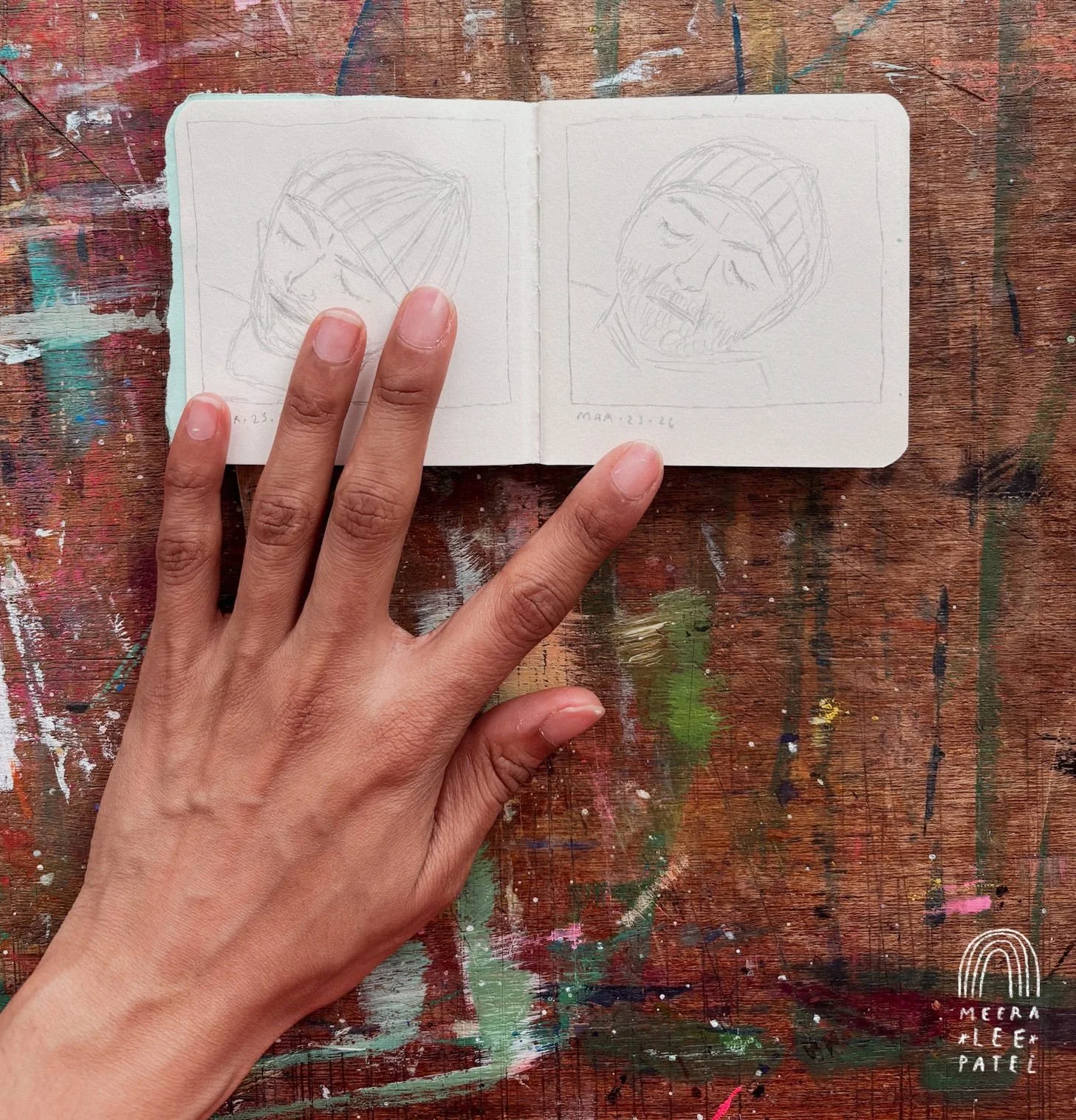
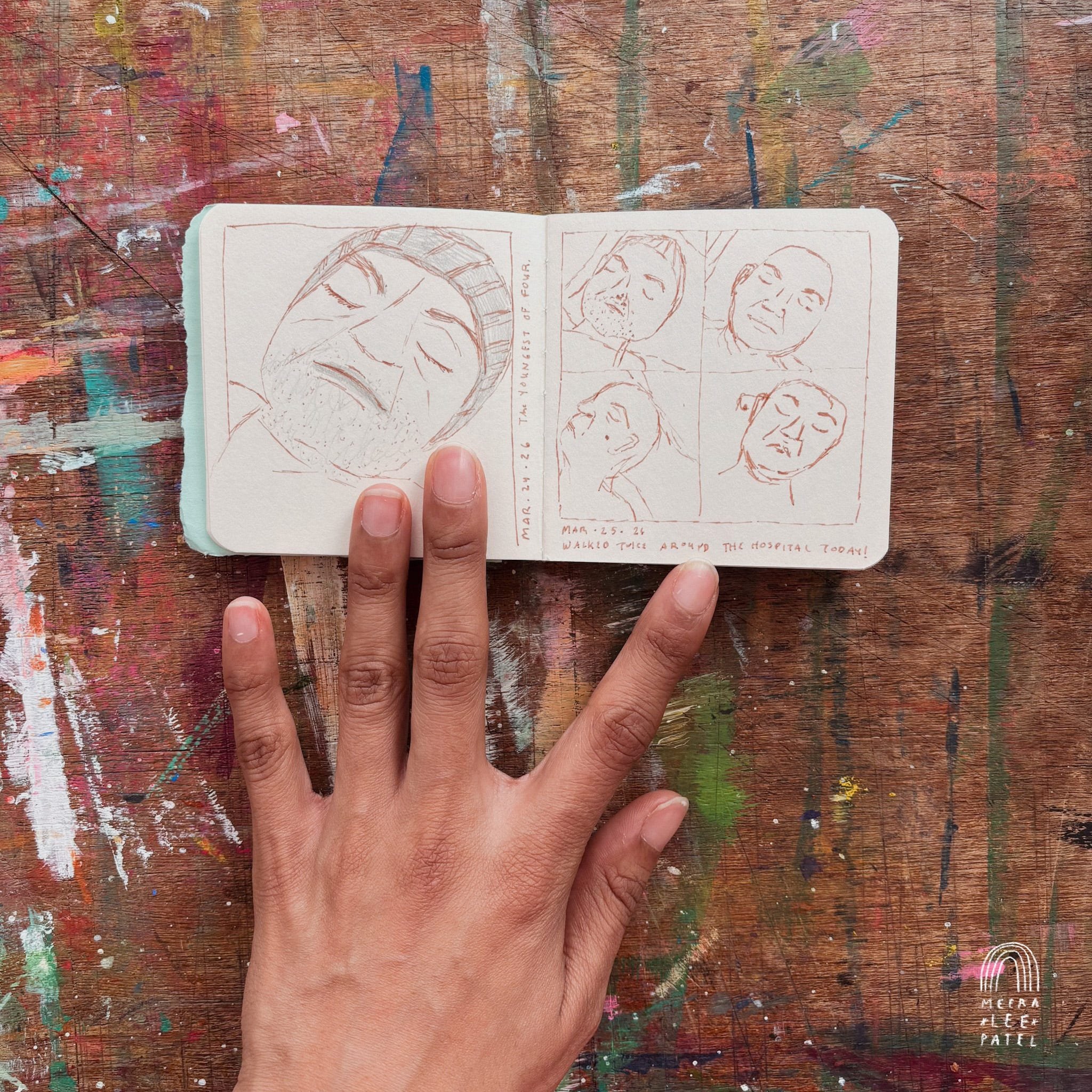
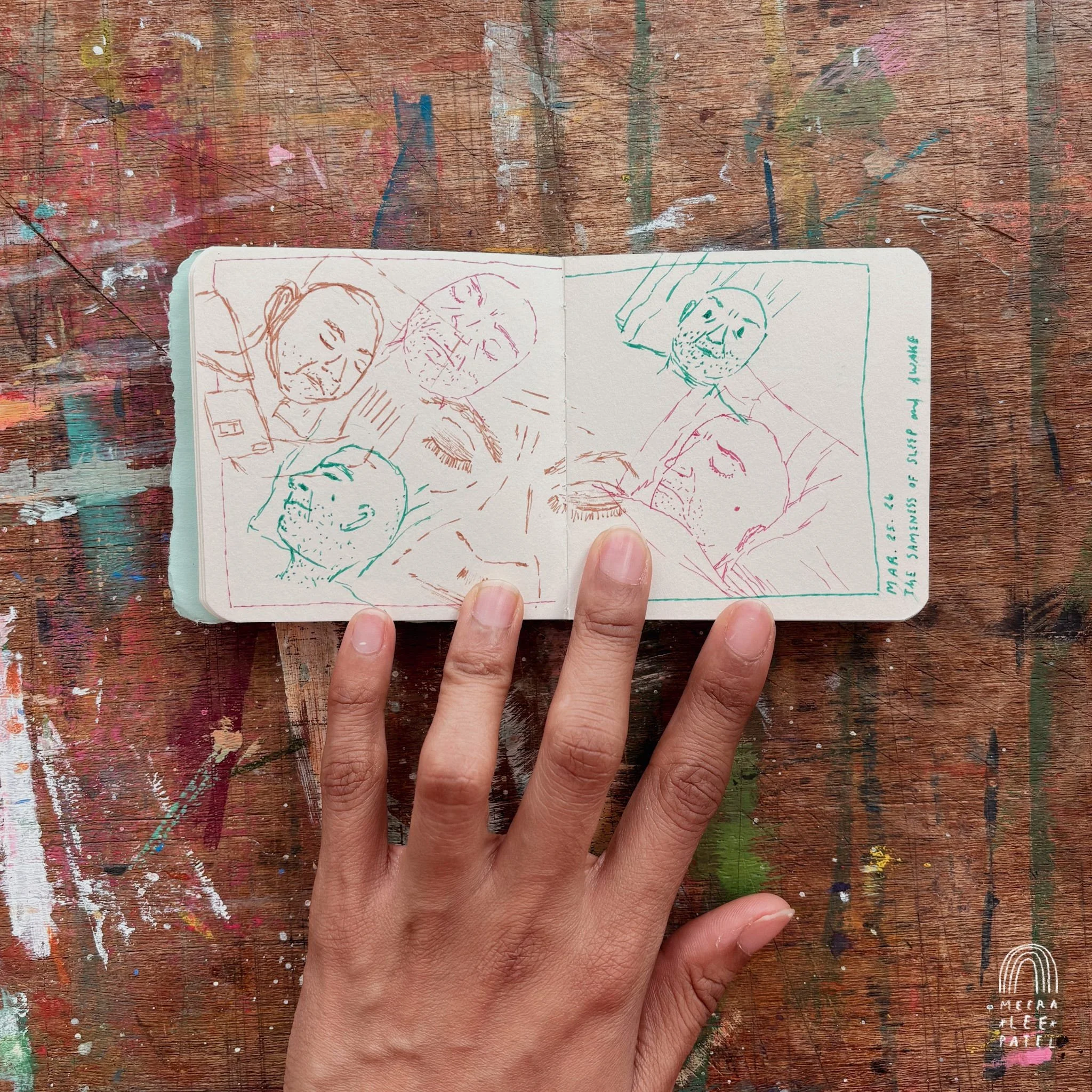
Pops in March (sketchbook, 2026)
Pops in March (sketchbook, 2026)
Pops in March (sketchbook, 2026)

I’m no good at capturing likeness, but for once, I don’t let it bother me. I just focus on the moment, the drawing, the memory. Everything changes in time.

WEDNESDAY

I’ve cited this passage in my newsletter before, and I’ve no doubt I will do so again; it is one that I return to repeatedly as the years roll on by:

“Care is like ephemeral art—an Andy Goldsworthy sculpture of mac and cheese and baby wipes and no tears shampoo and socks that never match and chore charts that never work and all that just gets blown away with the winds of time. And like art that isn’t static, isn’t permanent, can’t be put up on a wall and admired in a museum—care is devalued. We stumble on it sometimes in the wild and it takes our breath away, a momentary glimpse of the tenderness with which we hold and protect and nourish and delight in our loved ones; just like one of Goldsworthy’s mandala’s, there’s a divine structure to it, a feeling of inevitability. It’s as ordinary as dirt and as sacred as the kind found at Chimayo. It’s here, there, and everywhere, so kind of nowhere.

Caring for someone you love is, of course, a reward on to itself, the deepest of them, but it need not be labor that happens in such embattled circumstances. It could be absorbed and still revered, invisible and still funded, ephemeral and still prized. It could be held as the center of our existence, rather than the thing we rush through to get to our “real work.” We could see and honor the seasons—caring for children, caring for elders—and the variable capacities—the neurodivergent and disabled and chronically and temporarily ill.

I wish we had policy and professional expectations that mirrored our better angels, which show up again and again and again. Meanwhile, the winds will keep blowing away our beautiful care. That’s okay. That’s as it should be. Most of what is wildly worthwhile is achingly impermanent.”

—from Courtney Martin’s The Art of Care Mostly Disappears

THURSDAY

Some folks’ lives roll easy as a breeze, drifting through a summer night; but most folks’ lives, oh, they stumble, Lord, they fall; some folks’ lives never roll at all. 

FRIDAY

It is a kind of love, is it not?
How the cup holds the tea,
How the chair stands sturdy and foursquare,
How the floor receives the bottoms of shoes
Or toes. How soles of feet know
Where they’re supposed to be.
I’ve been thinking about the patience
Of ordinary things, how clothes
Wait respectfully in closets
And soap dries quietly in the dish,
And towels drink the wet
From the skin of the back.
And the lovely repetition of stairs.
And what is more generous than a window?

—The Patience of Ordinary Things by Pat Schneider

  • Dear Somebody: Tiny joys. (April 4, 2025)

Of all the things you can put in front of your eyes, I’m grateful that my little letter is one of them. 

If you’d like to support me, please buy my books. My art prints and line of greeting cards make excellent gifts for yourself or a friend. You can also hire me for your next project—I’d love to work together. 

xx,
M


To sign up for my weekly newsletter, Dear Somebody, please subscribe here.
In Life, Sketchbook Tags Parents, Life, Pat Schneider, Paul Simon, Courtney Martin, Sketchbook
Comment

Dear Somebody: Should I be doing more?

January 24, 2025

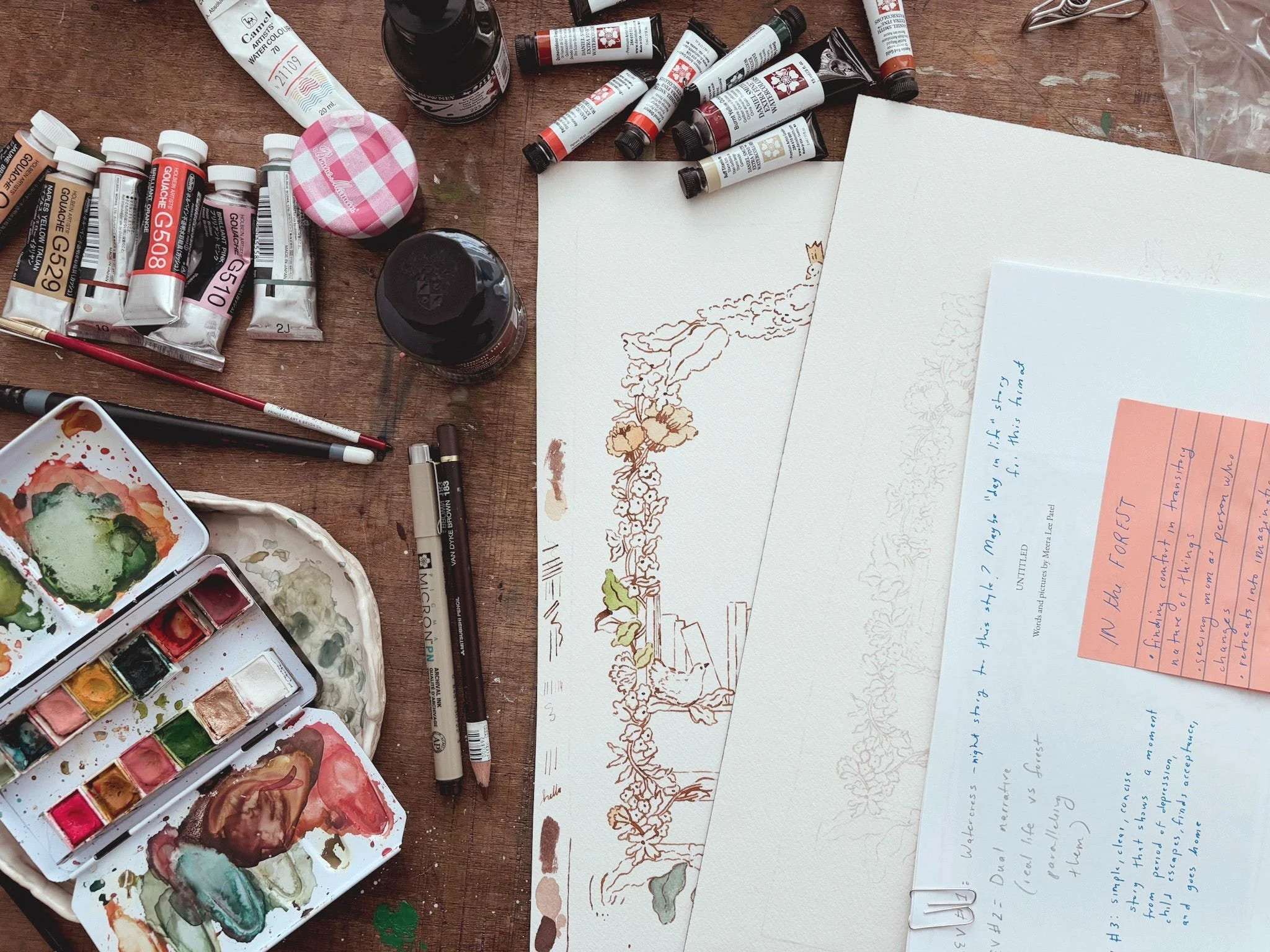
My desk this week: color studies, sketches, rewrites (2025)

A year from now, here are five things from this week that I'd like to remember:

MONDAY 

Lately, the position I find myself in most in nose to the ground, cleaning up after F’s meals. I sweep up crumbs and half-chewed banana, along with entire chunks of sandwich that have fallen out of her grinning mouth. Mine is a kid whose laughter will not wait for a bite to be chewed or properly swallowed; whose joy will not be tamed by rules or fatigue or her sister’s annoyance—whose joy is, in fact, a medicine for even-reasonable rules or well-earned fatigue or understandable annoyance; whose heart will not falter or close, even as mine does, at the state of this world. 

Lately, the position I find myself in most is sleepwalking to F’s room around midnight, then two am, then three, and four. For months now she’s been wide awake when she should be sleeping, and over these past few weeks, she’s begun screaming, too. I wonder if the world’s collective anxiety seeps into her skin during the dark hours of the night, if she is so annoyed at our inability to separate wrong from right that she’s resorted to screaming. 

When I lift her out of bed, she clings to me with relief. At nearly two years old, F is still a tiny thing, a baby monkey smuggling herself away in my arms. Outside of this room, beyond the walls of my home, families are bundled up and sent back to countries they don’t recognize. Others move of their own accord, to states and cities who will attempt to protect them when the rest of their country will not. Some go to school and don’t return home because their friends and neighbors believe real freedom is the power to destroy another person’s world. 

Safety is a matter of luck, and I was born on the side of it that faces up—the side sunlight reaches after it travels through a thousand years of cold and darkness. 

Lately, the position I find myself in most is stiff-necked, eyes closed, breathing in my kid’s presence and thinking of all the others. I breathe in her brown skin’s scent and consider what I can do—how I can transform the small marble of hardness in my own heart into something new, something that will help someone else. I breathe in my kid’s spirit and I know I can try harder. I breathe in my kid’s pulse and my heart, a temperamental old thing, slowly begins to open once more.

TUESDAY

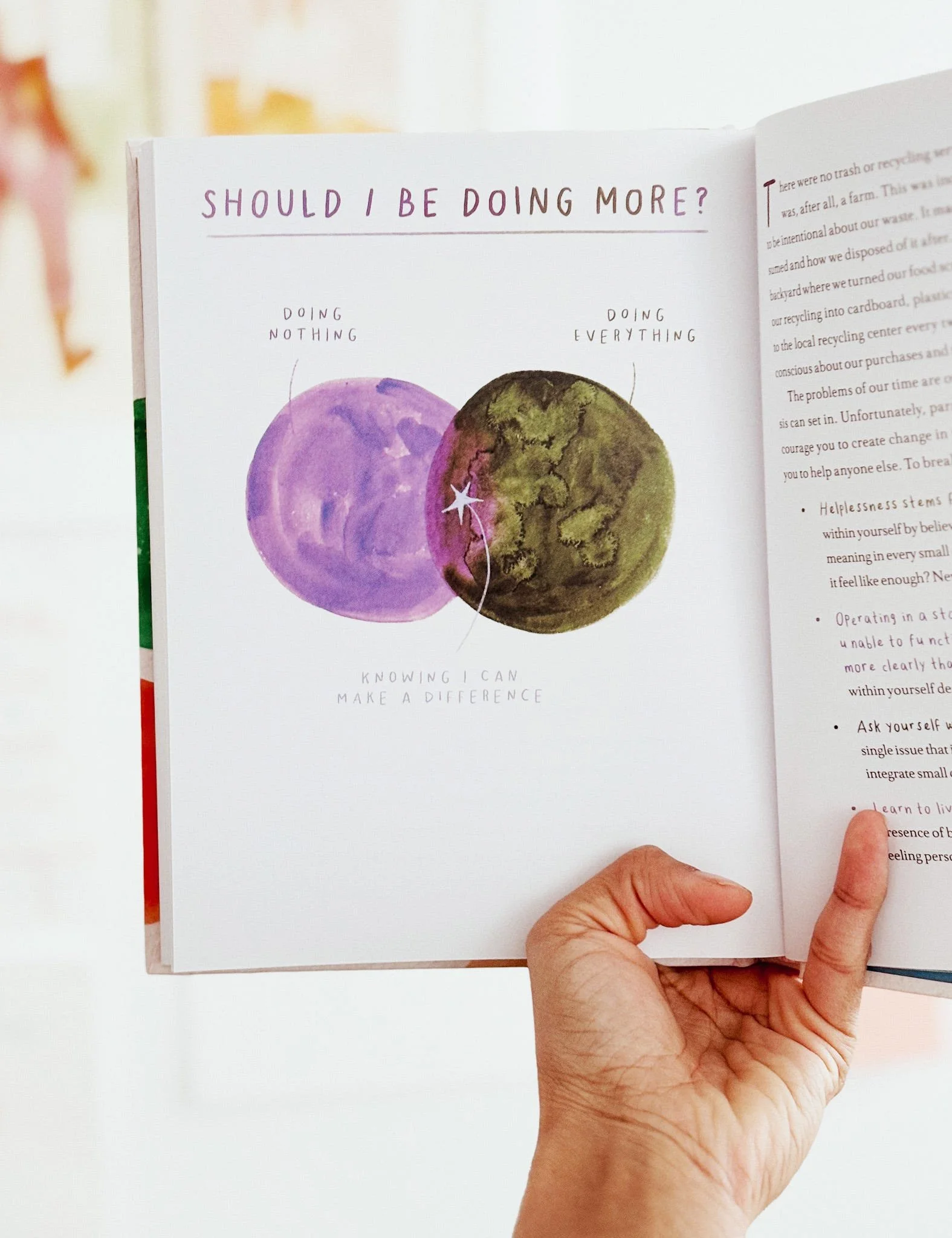
The problems of our time are overwhelming—so much so that a paralysis can set in. Unfortunately, paralysis is just that: paralysis. It doesn’t encourage you to create change in yourself or the world, and it doesn’t allow you to help anyone else. 

  • Helplessness stems from inaction. Commit to fostering hope within yourself by believing that your actions matter—that there is meaning in every small deed, even if it seems underwhelming. Does it feel like enough? Never. Is it better than doing nothing at all? Yes.

  • Operating in a state of total despair (or worse, being unable to function)doesn’t mean you see reality more clearly than those who are content.Cultivating joy within yourself despite the realities that surround you is a strength.

  • Ask yourself which causes align with your values. Choose a single issue that is close to your heart. Learn more about it, and slowly integrate small changes in your lifestyle that support these causes.

  • Learn to live with a certain amount of fear and anxiety. Remember that the presence of both indicates that you care—that you’re a thoughtful, feeling person who wants to make a difference.

—Excerpted from How it Feels to Find Yourself: Navigating Life’s Changes with Clarity, Purpose, and Heart, my book of illustrated essays.

WEDNESDAY

“People are redefining ambition. Most of us who hit 40 have had enough experiences—winning and losing—to know that it is all actually “winning” and “losing.” The best job in the world can also cause you profound stress. Getting the promotion, raise, book deal that you always wanted, might feel like a hard-won achievement in certain ways, and in others, it is likely to be anti-climatic and send you spinning off into a moment of existential confusion. If you’ve experienced the texture of work long enough, you start to sober up about what really matters to you, what you are really made for, and what you want to spend your precious energy and time on. You understand that the deepest sense of self-realization doesn’t come through paychecks or titles, but through genuine, intrinsic pride that you have done something you are delighted by with people who delight you. Midlife is a moment to seek a more finely calibrated understanding of all of this and start advocating for yourself within work settings (whether that means joining a labor union or saying no more to freelance work or not tolerating assholes). Of course the most insecure your financial situation, and the less lucrative your life’s work, the more constraints you face on living into these truths. Which is why economic disparity is about so much more than “food on the table,” but people’s ability to give the world their best gifts and live their fullest, most realized lives.” —From Courtney Martin’s Grow Bigger, Not Bitter

THURSDAY

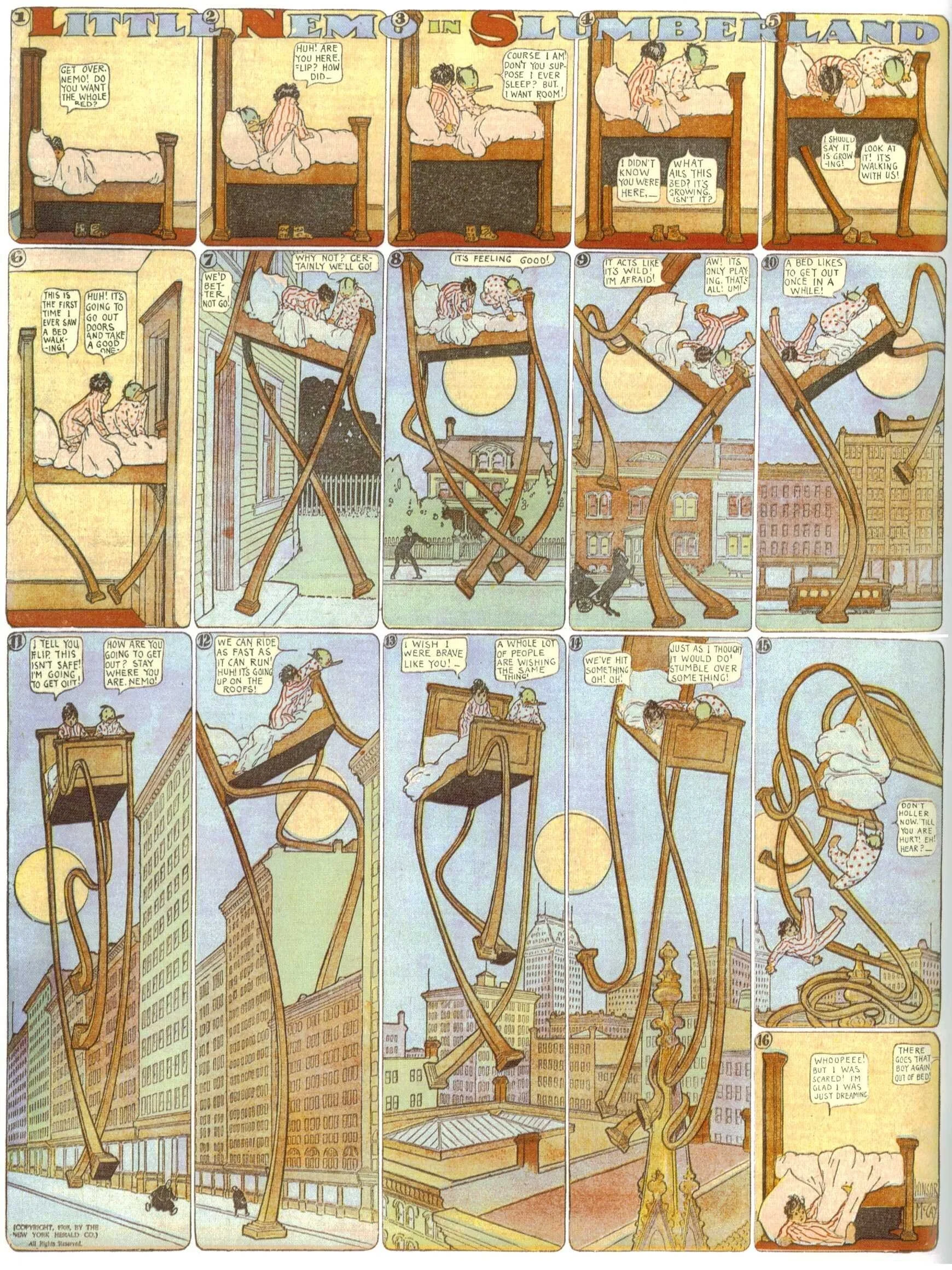
Winsor McCay, Little Nemo in Slumberland, 26 July 1908

The animated legacy of Little Nemo’s walking bed: I read Little Nemo as a child; as an adult, I have a deep appreciation for Winsor McCay’s imagination and drawing ability. I find more and more that McCay’s tight lines and evocative color palette are influencing how I think about drawing and the drawings I want to make—that maybe “fun” in drawing doesn’t necessarily mean spontaneity in line or execution, but fluidity in thought and effective communication. 

FRIDAY

I can hardly imagine it
as I walk to the lighthouse, feeling the ancient
prayer of my arms swinging
in counterpoint to my feet.
Here I am, suspended
between the sidewalk and twilight,
the sky dimming so fast it seems alive.
What if you felt the invisible
tug between you and everything?
A boy on a bicycle rides by,
his white shirt open, flaring
behind him like wings.
It’s a hard time to be human. We know too much
and too little. Does the breeze need us?
The cliffs? The gulls?
If you’ve managed to do one good thing,
the ocean doesn’t care.
But when Newton’s apple fell toward the earth,
the earth, ever so slightly, fell
toward the apple as well.

—The World Has Need of You by Ellen Bass

See you next week!

xx,

M


To sign up for my weekly newsletter, Dear Somebody, please subscribe here.
In Sketchbook, Process, Motherhood Tags Parenting, Parenthood, Safety, Helplessness, inaction, despair, values, How it Feels to Find Yourself, Books, Courtney Martin, Winsor McCay, Little Nemo, Ellen Bass
Comment

Dear Somebody: A lesson in unconditional love.

November 10, 2023

A paint palette from How it Feels to Find Yourself

A year from now, here are five things from this week that I'd like to remember:

MONDAY 

I wake up tired. It’s 4:35 am and our 5-month-old is crying. I sit up, swing my legs over to the edge of the bed, and stumble towards the door. Jack has been up for some time now, waiting for us to wake. He dances around my feet, tip-tapping excitedly, wanting me to sit down and play with him. “I need a minute, Jackie,” I mumble, stepping over him and into the bathroom. He watches as I brush my teeth and splash cold water on my face. I feel irritated for no reason. After a few minutes, I close the door.

By 6:00 am, the baby has been changed and fed and cried a few more times. We’re sitting on the floor playing peek-a-boo, waiting for the sun to show her face. Jack sits by the bedroom door, waiting. Every so often, he looks over to see how we’re doing.

Around 6:45, I get dressed. Jack bounces around my heels as I pull on pants and a hoodie. “Jack. Jackie. I need some space,” I say, more gently than I have before. When we reach the back door, he’s there, waiting. I let him out and he races around the yard, joyfully feeling the cool air on his face. The trees are dropping their leaves now, and the crinkle of each one fills my ears. The scent of morning dew after a long fall from the sky passes over us in waves. I breathe in deeply and will myself into feeling new. I want to be better—patient, kind, more appreciative of all the good I have. Jack walks over and sits down next to me, so closely that his body is on my feet. His head rests under my hands. He waits. 

—from ”A Lesson in Unconditional Love” in How it Feels to Find Yourself

TUESDAY

This interview with Blexbolex about The Magicians; this letter by Ruth Franklin of Ghost Stories about the purpose of art in dark times; this conversation on moving past your own self-doubt between Lizzy Stewart and Andy J. Pizza.

WEDNESDAY

Teared up reading today’s note from Courtney Martin, a letter about her daughter turning 10. I myself can hardly fathom a world in which my daughters are 10, or 11, or anything except so small. In it, she writes:

When we were driving home so slowly that day, I never could have predicted any of this—that, ironically, my firstborn would gift me with nourishing, companionable quiet, and return me to my love of solitude and art, and speak an emotional language so foreign to me it would humble me in all the right ways.

I think about this constantly—how N and F are their own mysterious beings, equipped with their own arsenal of language, philosophy, and thought. How they are not extensions of me. How I am humbled continually by how easily they find and hold onto anything good. How they do not dwell. How deeply they feel about their perceived injustices. How it’s not my job to tell them what they should think or feel, but help them find the words to articulate what they do think and feel. How it’s my job to guide them, yes, but how mostly it’s my job to stay out of their way—so they can show me, and the rest of the world, who they are. 

THURSDAY

In the very little time I have to make things, I have been trying, very hard, to make things. Sometimes this is during F’s nap. Often it is while we go on walks. I walk and write poems in my head, on my Notes app. I text lines of poems or this newsletter to myself. I try to capture what I feel in words, hoping that eventually, I’ll be able to translate it into a picture. I draw on the couch after the girls are in bed. I draw when I should be sleeping. Sometimes I draw instead of showering. 

I fret a lot—not about the time I’m losing, but about whether I’ll still want to make the things I want to make when I do have the time. Whether I’ll still feel the spark. Whether the making part of me will keep waiting for the rest of me to catch up.

Two pieces I made this year that I finally framed, ready to hang in our home.

I took the time to frame these two illustrations this week. We’re going to hang them up in our house. Each one took too long to make by any reasonable person’s standards. If I divide the amount of time it took to draw each one by the rate I was paid, it comes out to exactly nothing. If I add up the additional costs—time with my family, regular hygiene, a semblance of a social life, an earlier bedtime—things start to sound a little ridiculous. I start to feel ridiculous. I have written about this period of motherhood before.

But when I look at these two illustrations together, I see that the making part of myself is alive and well. That it is being tended to. That despite being obviously neglected, my creativity is climbing back into my life. Into where it belongs. That it is creating its own space in the places I have abandoned. That it refuses to be forgotten. That I have not left this very integral—perhaps the most integral part of myself, behind. That what’s good is slow in its making, but that the making part is very good, too. That, however slowly, my art is growing and changing, and I am, too—and that both are well worth the costs.

FRIDAY

Before you know what kindness really is
you must lose things,
feel the future dissolve in a moment
like salt in a weakened broth.
What you held in your hand,
what you counted and carefully saved,
all this must go so you know
how desolate the landscape can be
between the regions of kindness.
How you ride and ride
thinking the bus will never stop,
the passengers eating maize and chicken
will stare out the window forever.

Before you learn the tender gravity of kindness
you must travel where the Indian in a white poncho
lies dead by the side of the road.
You must see how this could be you,
how he too was someone
who journeyed through the night with plans
and the simple breath that kept him alive.

Before you know kindness as the deepest thing inside,
you must know sorrow as the other deepest thing.
You must wake up with sorrow.
You must speak to it till your voice
catches the thread of all sorrows
and you see the size of the cloth.
Then it is only kindness that makes sense anymore,
only kindness that ties your shoes
and sends you out into the day to gaze at bread,
only kindness that raises its head
from the crowd of the world to say
It is I you have been looking for,
and then goes with you everywhere
like a shadow or a friend.

—Kindness by Naomi Shihab Nye

xx,

M


To sign up for my weekly newsletter, Dear Somebody, please subscribe here.
In Life Tags How it Feels to Find Yourself, Love, Essays, Writing, Meera Lee Patel, TarcherPerigee, Penguin Random House, Parenting, Parenthood, Motherhood, Paint Palettes, Blexbolex, The Magicians, Ruth Franklin, Ghost Stories, Lizzy Stewart, Andy J. Pizza, Self-Doubt, Courtney Martin, Daughter, Kindness, Naomi Shihab Nye, Poetry
Comment

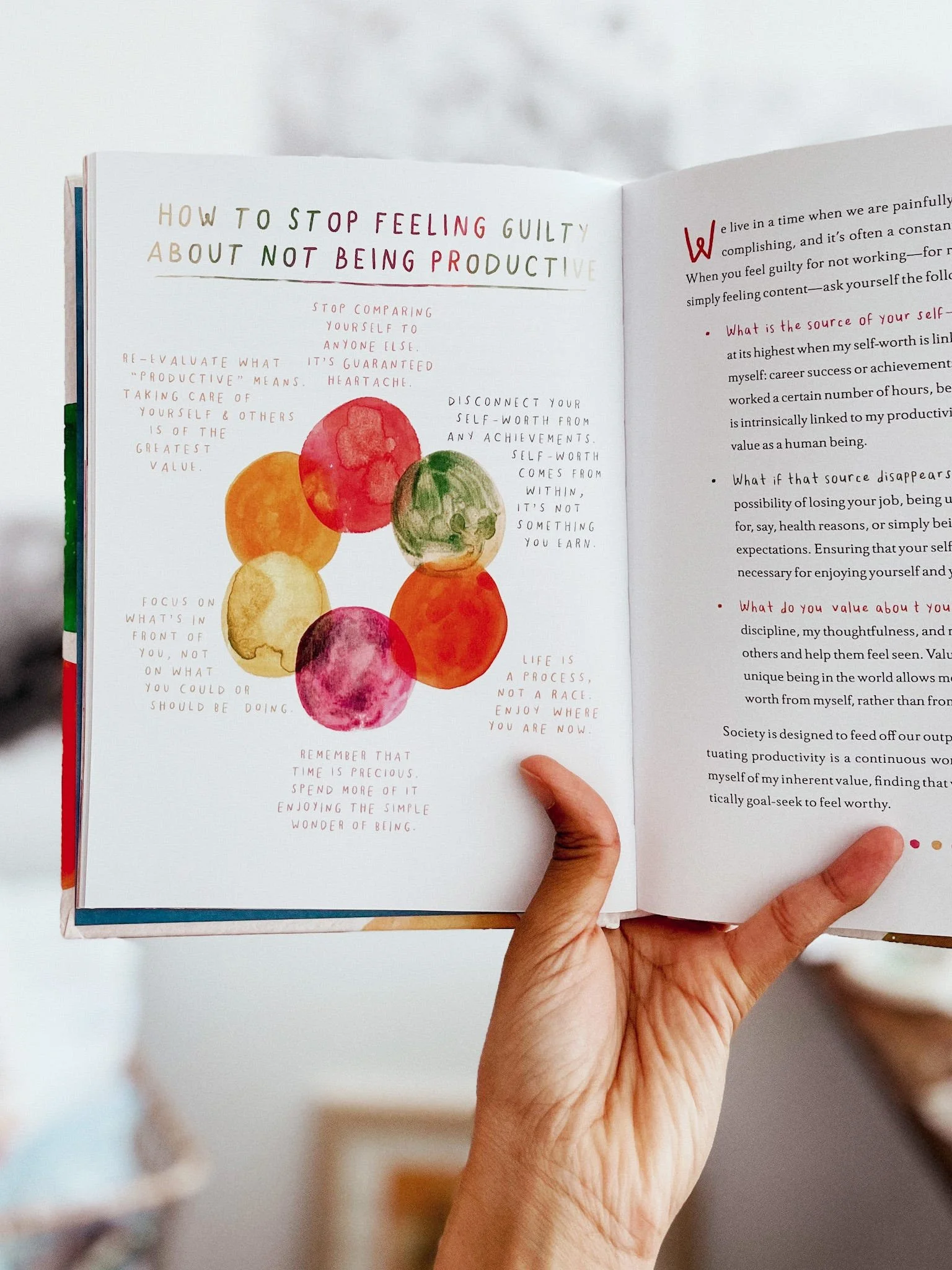
Dear Somebody: How to stop feeling guilty about not being productive

May 26, 2023

A paint palette and accompanying essay from How it Feels to Find Yourself

A year from now, here are five things from this week that I'd like to remember:

MONDAY

When you know yourself well, it’s easier to locate the significance in every small moment. Your capacity to retain peace during difficult transitions increases. You understand that most situations have more than one correct answer. You feel freer.

The most important relationship we can spend our lives nurturing is the relationship we have with ourselves. The lens through which we view ourselves determines our connection to the world. If that lens is cracked or cloudy, each of our relationships begins to suffer. Building a strong internal compass that skillfully guides you through life’s uncertainties is possible only by developing an intimate, healthy relationship with yourself. Through this process of continued self-exploration, I began to learn who I am, what my purpose is, and how to intentionally shape my life into one I recognize with joy. Living well means adapting to life’s constant transition; evolving with purpose and clarity is a skill I now practice regularly. This is how I found myself—for the first time, and then again, every time after that.  

—An excerpt from the introduction of How it Feels to Find Yourself

TUESDAY

It’s 4:00 in the morning and How it Feels to Find Yourself will be published today. I feel sloppy and underprepared, like I’m about to take a test I haven’t studied for. In all the chaos of the last few months, I’ve barely been able to put much time into promoting this book. As fellow authors know, especially those who write for adults—your work isn’t over when you finish writing the book. The publicity and marketing aspect of publishing is overwhelming for those of us who prefer staying out of the limelight. I personally prefer being behind a desk than a camera; book promotion demands I summon the extrovert inside me, however well she may have hidden. 

Anyway. It’s 4:00 and we’re up to feed the baby, it being 2.5 hours since she’s last eaten. I stumble around in a haze, changing her diaper and tending to her spit-up, shoving a pacifier in her small. sweet mouth as her little lungs get ready to scream. I hand her to T who looks like a zombie but sits in the recliner to give her a bottle anyway. I gotta write my newsletter, I mumble sleepily, and he nods. 

Back in bed, it’s 4:30 am. I open my laptop and begin to write, promising myself that this is the last crazy thing I’ll do in a long while. I’m going to sleep instead of writing newsletters at 4:30 in the morning, I tell myself. I’m going to exercise instead of giving birth a few weeks prior to completing graduate school, I tell myself. I’m going to delight in healthier cooking and eating instead of working myself to the bone. 

I finish writing and close the laptop. I check on T and the baby, both of whom are asleep again, the steady rise and fall of their chests following each breath. I pull the covers up to my nose and exhale deeply. This is the last crazy thing I do, I repeat to myself. 

This is the summer of long walks and less running around. This is the summer of cookouts and lazy pool days and no homework. This is the summer of breathing in baby and being crazy with toddler. This is the summer of new recipes and friendships and sleep and smiles. This is the summer I see more and do less. This is the summer I read more and write less. This is the summer for rest and replenishing. This is the summer of silence. 

I will not feel guilty for not being productive. And maybe, months from now, when I feel good and ready—I will begin again. 

WEDNESDAY

Most of us who hit 40 have had enough experiences—winning and losing—to know that it is all actually “winning” and “losing.” The best job in the world can also cause you profound stress. Getting the promotion, raise, book deal that you always wanted, might feel like a hard-won achievement in certain ways, and in others, it is likely to be anti-climatic and send you spinning off into a moment of existential confusion. If you’ve experienced the texture of work long enough, you start to sober up about what really matters to you, what you are really made for, and what you want to spend your precious energy and time on. You understand that the deepest sense of self-realization doesn’t come through paychecks or titles, but through genuine, intrinsic pride that you have done something you are delighted by with people who delight you. Midlife is a moment to seek a more finely calibrated understanding of all of this and start advocating for yourself within work settings (whether that means joining a labor union or saying no more to freelance work or not tolerating assholes). Of course the most insecure your financial situation, and the less lucrative your life’s work, the more constraints you face on living into these truths. Which is why economic disparity is about so much more than “food on the table,” but people’s ability to give the world their best gifts and live their fullest, most realized lives.

—An excerpt from Grow Bigger Not Bitter by Courtney Martin 


THURSDAY

A simple photograph to celebrate this week, this book, and a vow to be less measurably productive:

FRIDAY

My shadow said to me:
what is the matter
Isn’t the moon warm
enough for you
why do you need
the blanket of another body
Whose kiss is moss
Around the picnic tables
The bright pink hands held sandwiches
crumbled by distance. Flies crawl
over the sweet instant
You know what is in these blankets
The trees outside are bending with
children shooting guns. Leave
them alone. They are playing
games of their own.
I give water, I give clean crusts
Aren’t there enough words
flowing in your veins
to keep you going. 

—The Shadow Voice by Margaret Atwood


xx,

M


To sign up for my weekly newsletter, Dear Somebody, please subscribe here.

In Writing Tags How it Feels to Find Yourself, Paint Palettes, Books, Writing, Essays, Excerpt, Publication Day, Pub Day, Productivity, Courtney Martin, Grow Bigger Not Bitter, The Shadow Voice, Margaret Atwood, Poetry
Comment

Dear Somebody: How to keep going

March 17, 2023

The final essay from my upcoming book, How it Feels to Find Yourself

A year from now, here are five things from this week that I'd like to remember:

MONDAY

For a limited time, my friends at BuyOlympia are giving away a free, 5”x7” limited edition print of my How To Keep Going paint palette with every pre-ordered copy of How it Feels to Find Yourself. 

This palette, in particular, is special to me. It accompanies the final essay in the book and is a daily reminder and source of encouragement to find the inner strength and commitment to keep going. 

This illustration outlines the steps that I’ve always relied on in moments of hopelessness and discouragement: accepting life’s duality, finding meaning in the difficult and joyful, keeping what’s useful (while discarding the rest), letting go of “should”, making peace with change, and beginning again. 

Pre-order your copy and complimentary art print here.

TUESDAY

“What do you think an artist is?…he is a political being, constantly aware of the heart breaking, passionate, or delightful things that happen in the world, shaping himself completely in their image. Painting is not done to decorate apartments. It is an instrument of war.” 

—Pablo Picasso

WEDNESDAY

“There are two kinds of truth: the truth that lights the way and the truth that warms the heart. The first of these is science, and the second is art. Neither is independent of the other or more important than the other. Without art science would be as useless as a pair of high forceps in the hands of a plumber. Without science art would become a crude mess of folklore and emotional quackery. The truth of art keeps science from becoming inhuman, and the truth of science keeps art from becoming ridiculous.”

—from The Notebooks of Raymond Carver by Raymond Carver

THURSDAY

“Don’t wait for someone to tell you that your project is worthwhile. If you’re moved to write, draw, create, produce something, that’s all the permission you need to devote some time and energy to it. Make a commitment to yourself. Some of my most rewarding collaborations over the many decades have been totally homegrown, grassroots situations (like the Secret Society for Creative Philanthropy) that ended up reaching really wide audiences because—in part—they were unfettered by “too many cooks in the kitchen” bullshit or the bad advice of supposed experts.”

—10 Thoughts on Building a Life You Love by Courtney Martin in The Examined Family

FRIDAY

I.
In March the earth remembers its own name.
Everywhere the plates of snow are cracking.
The rivers begin to sing. In the sky
the winter stars are sliding away; new stars
appear as, later, small blades of grain
will shine in the dark fields.

And the name of every place
is joyful.

II.
The season of curiosity is everlasting
and the hour for adventure never ends,
but tonight
even the men who walked upon the moon
are lying content
by open windows
where the winds are sweeping over the fields,
over water,
over the naked earth,
into villages, and lonely country houses, and the vast cities

III.
because it is spring;
because once more the moon and the earth are eloping -
a love match that will bring forth fantastic children
who will learn to stand, walk, and finally run
    over the surface of earth;
who will believe, for years,
that everything is possible.

IV.
Born of clay,
how shall a man be holy;
born of water,
how shall a man visit the stars;
born of the seasons,
how shall a man live forever?

V.
Soon
the child of the red-spotted newt, the eft,
will enter his life from the tiny egg.
On his delicate legs
he will run through the valleys of moss
down to the leaf mold by the streams,
where lately white snow lay upon the earth
like a deep and lustrous blanket
of moon-fire,

VI.
and probably
everything
is possible.

—Worm Moon by Mary Oliver

xx,

M


To sign up for my weekly newsletter, Dear Somebody, please subscribe here.

In Life Tags How it Feels to Find Yourself, BuyOlympia, Paint Palettes, How to Keep Going, Illustration, Pablo Picasso, Raymond Carver, The Notebooks of Raymond Carver, Truth, The Examined Family, Courtney Martin, 10 Thoughts on Building a Life You Love, Secret Society for Creative Philanthropy, Mary Oliver, Worm Moon
Comment

Dear Somebody: Our mothers and fathers.

February 17, 2023

Maja, gouache and colored pencil on 16”x20” Arches paper. Currently on view at the Washington University Graduate Center

A year from now, here are five things from this week that I'd like to remember:

MONDAY

Most days after lunch, I go for a walk with my dad. I put on my shoes and coat and wait for him by the door. I’m impatient, feeling like a little kid waiting to be driven to school. Sometimes my dad does drive me to school, just like he did when I was growing up, the only differences being that it’s now 25 years later, I’m in graduate school and married with a kid, and he’s retired. 

I’m in my mid-thirties and he’s nearing 70, so it feels a little silly that my dad still takes care of me. It makes me feel even more childlike than I normally do. I get frustrated when he won’t let me carry a heavy bag home or cautions me against walking too fast. He frequently reminds me of things that are impossible to forget, namely that there’s a baby in my belly and I need to take care of myself. Before dinner he slices guava into pieces, sprinkling each with salt, pepper, cumin, and red chili. We eat them in silence, crunching the seeds.

Most evenings after dinner, I power walk around my parents’ apartment in an effort to lower my blood sugar. I start by the living room window and walk straight into the kitchen, around the tiny dining table replete with folding chairs, past the cabinet filled with dozens of glass jars holding seeds, nuts, and flours, past the couch where T and my mother sit talking or reading the news, and straight back towards the window again. If N has already taken her bath, she joins me. “We’re doing exercise!” she shouts with glee, running faster with each lap, cajoling me to keep up with her. She holds my hand with one hand and her belly with the other, mimicking the way I support the baby swimming inside me while waddling around the cozy apartment. 

These walks are the markers of my days: the one I take alone after breakfast, the one with my dad after lunch, the one with my daughter after dinner. They will come to an end quickly, I know. In a few months, the baby will come, and after that, graduation. My parents will move back home and there will be no more walks with dad—after lunch or at any other point during my days. 

I consider this small sorrow daily, usually while putting on my shoes. And then I wait for my dad by the door. 

TUESDAY

“Care is like ephemeral art—an Andy Goldsworthy sculpture of mac and cheese and baby wipes and no tears shampoo and socks that never match and chore charts that never work and all that just gets blown away with the winds of time. And like art that isn’t static, isn’t permanent, can’t be put up on a wall and admired in a museum—care is devalued. We stumble on it sometimes in the wild and it takes our breath away, a momentary glimpse of the tenderness with which we hold and protect and nourish and delight in our loved ones; just like one of Goldsworthy’s mandala’s, there’s a divine structure to it, a feeling of inevitability. It’s as ordinary as dirt and as sacred as the kind found at Chimayo. It’s here, there, and everywhere, so kind of nowhere.

Caring for someone you love is, of course, a reward on to itself, the deepest of them, but it need not be labor that happens in such embattled circumstances. It could be absorbed and still revered, invisible and still funded, ephemeral and still prized. It could be held as the center of our existence, rather than the thing we rush through to get to our “real work.” We could see and honor the seasons—caring for children, caring for elders—and the variable capacities—the neurodivergent and disabled and chronically and temporarily ill.”

—The art of care mostly disappears from Courtney Martin’s The Examined Family

WEDNESDAY

The perfect way to begin this morning is by listening to the Our House demo with Graham Nash and Joni Mitchell while making N’s lunch and rubbing the sleep from our eyes. 

THURSDAY

We’ve heard a lot about quiet quitting lately, but this post by my friend and artist Lisa Congdon, about loud quitting, really stayed with me. In it, she writes: 

So far in the past 9 months, I’ve quit alcohol, food restrictions, teaching college, my podcast (more on that to come), two boards of directors, working on Fridays, working on umpteen client projects at once, coffee dates with people I don’t know, most public speaking, writing any more books, several friendships, and most weekday evening plans. I have not felt as happy, “balanced” (if such a thing exists) and such a sense of spaciousness in nearly 20 years. 

I’ve begun to think of this as “loud quitting” — intentional, communicated, assertive (as opposed to passive), and unapologetic. So, to be clear, this not necessarily the opposite of “quiet quitting,” which is about not going above and beyond in the workplace (which I also support) — just simply my way of overtly claiming and taking control over my time in a way I haven’t in my entire life — because, for most of my 55 years, I thought it was literally my duty to please/serve others. 

I contributed a comment about my own long string of things I’ve quit this year, and it’s obvious that neither Lisa nor I are the only ones. The past few years have all added up to this one, where we’re rediscovering what our values and boundaries are—and that’s always something worth celebrating. 

FRIDAY

whose influences, we said,
    made us passive and over-polite
whose relationships with our fathers
    we derided at consciousness-raising groups
whose embroidered pillowcases still accuse us
    on the shelves of our modern lives

they have become interesting old women
they are too busy to write often
they wish we wouldn't worry about them
they are firm about babysitting
they are turning out okay

—Our Mothers by Leona Gom

If you'd like to support me, you can pre-order my upcoming book of illustrated essays, How it Feels to Find Yourself, for yourself, a loved one, or both! My art prints, stationery, and books are available through BuyOlympia. You can also pledge your support for this newsletter by becoming a future paid subscriber. 

xx,

M


To sign up for my weekly newsletter, Dear Somebody, please subscribe here.

In Life Tags Graduate School, Parents, Walking, Andy Goldsworthy, Caring, Love, Courtney Martin, The Examined Family, Graham Nash, Joni Mitchell, Our House, Quiet Quitting, Lisa Congdon, Balance, Leona Gom, Our Mothers
Comment

Meera Lee Patel is an artist, writer, and book maker. Her books have sold over one million copies, and been translated into over a dozen languages worldwide.

Her newsletter, Dear Somebody, is a short weekly note chronicling five things worth remembering, including a look into her process, reflections on motherhood, and creative inspiration.

Join thousands of other readers by subscribing.


Latest Posts

Featured
Apr 10, 2026
Dear Somebody: The hard work of it makes me shine.
Apr 10, 2026
Apr 10, 2026
Apr 3, 2026
Dear Somebody: A thousand years.
Apr 3, 2026
Apr 3, 2026
Mar 6, 2026
Dear Somebody: On giving up.
Mar 6, 2026
Mar 6, 2026
Feb 20, 2026
Dear Somebody: A monster inside the wall.
Feb 20, 2026
Feb 20, 2026
Jan 30, 2026
Dear Somebody: More Than Machine.
Jan 30, 2026
Jan 30, 2026

categories

  • Books 12
  • Life 62
  • Motherhood 11
  • Picture Book 1
  • Process 31
  • Sketchbook 12
  • Writing 4
Full archive
  • April 2026 2
  • March 2026 1
  • February 2026 1
  • January 2026 3
  • December 2025 1
  • November 2025 1
  • October 2025 4
  • September 2025 3
  • August 2025 1
  • July 2025 1
  • June 2025 3
  • May 2025 3
  • April 2025 4
  • March 2025 1
  • February 2025 2
  • January 2025 3
  • December 2024 2
  • November 2024 2
  • October 2024 2
  • September 2024 3
  • August 2024 2
  • July 2024 2
  • June 2024 2
  • May 2024 3
  • April 2024 2
  • March 2024 4
  • February 2024 4
  • January 2024 3
  • December 2023 2
  • November 2023 2
  • October 2023 4
  • September 2023 5
  • July 2023 2
  • June 2023 2
  • May 2023 3
  • April 2023 2
  • March 2023 4
  • February 2023 3
  • January 2023 4
  • December 2022 2
  • November 2022 1
  • August 2022 1
  • July 2022 2
  • May 2022 2
  • April 2022 2
  • March 2022 1
  • January 2021 1

READ MY BOOKS


Copyright © 2023 Meera Lee Patel