• Learn to Let Go
  • Books for Everyone
  • Work
  • newsletter
  • Journal
  • Shop
  • About
Menu

Meera Lee Patel

ARTIST, WRITER, BOOK MAKER
  • Learn to Let Go
  • Books for Everyone
  • Work
  • newsletter
  • Journal
  • Shop
  • About

Dear Somebody: A thousand years.

April 3, 2026

The Biggest Dream, originally published in Issue #38 of Chickpea Magazine

A year from now, here are five things from this week that I'd like to remember:

MONDAY 

I’m sitting under the Dallas sun when I hear about the blood. The bleeds are two fish making their way through the currents of your brain and I wonder what they are looking for. What do they hope to find? Do they realize the disruptions they are causing?

I’m sitting in the DFW airport when it occurs to me that the fish inside your brain are still swimming, that possibly they’ve been swimming for a very long time. It occurs to me that sharks are a type of fish: stealthy, silent. Their bodies are made out of cartilage; they are unburdened by the weight of bone. Sharks sneak up on us when we finally set our anxiety aside, just long enough for a dip in the salty waters. Just long enough to enjoy life for a few minutes. I feel torn. I’m stuck between my own anger and the reality of knowing that no sharks singled you out. They were just hungry. You were just there.

I’m sitting in the ICU when I first see that the waves in your brain are large. Only a large object could cause such a disturbance, ripples that wash over your memory, your judgment, your speech. The brain is categorized into eight separate lobes and there is water, I mean, blood—everywhere. 

These are some big fish, I think to myself, trying to reach you through your closed eyes. I’ve spent years trying to catch the big fish, and here you caught two all on your own without even trying. I wonder if you’ve ever been whale watching; I don’t think you have. Maybe once in Hawaii? I begged you to take me fishing when I was a kid, but I don’t think we ever did…right? Right? I want you to wake up so I can confirm this information, but your eyes remain closed no matter how loud I scream.

I’m sitting in the hospital room next to you when you tell me the year is 1926. I don’t blink; I ask you to try again. You want to ask where my sister is, but you can’t retrieve her name. She’s coming soon, I tell you, and your face softens. What’s my name? I ask, and you hesitate. You don’t answer. I don’t blink; I don’t ask you to try again. I know you recognize who I am and the warmth of you washes over me. You’re still you, and I feel comforted by your presence, just like I did when I was a kid. Even though you don’t know my name. Even though everything has changed. 

I’m pulling a sheet over the chair next to your bed when you speak to me unprompted. I think I’m going to get better, you say, and my heart breaks over the light in you. Some people swallow a little of the sun and it stays with them forever; you did, and I know that. The sunlight beams out of your face brightly even though everything is cracked. It’s a light that always plays, even when it’s a bad hand, even when it’s easier to blame, to argue, to just plain quit. 

You lay down in bed and I lay down in the chair next to you. It is so loud in this room filled with patients and nurses and lights and flashes and I am filled to the nose with overwhelm and questions. How strong is each ripple moving through your brain? Will the water hurt or heal all that it touches? After everything evaporates, what will remain?

You are confused, displaced. I’m right here, I reassure you. It’s time for sleep. I think about how many times my small children have fought against the night, apprehensive about what happens after they close their eyes. I think about how many times I’ve waited until they’ve fallen asleep before backing out of their room slowly, sometimes on my knees. I think about how life is a ripple, a wheel that keeps turning. Time waits for no one.

It’s been one thousand years since I relied on parental presence to feel safe enough to close my eyes; for you, it’s been even longer. You’re my dad, and for the first time in a thousand years, I fall asleep holding your hand. And you fall asleep holding mine. 

TUESDAY
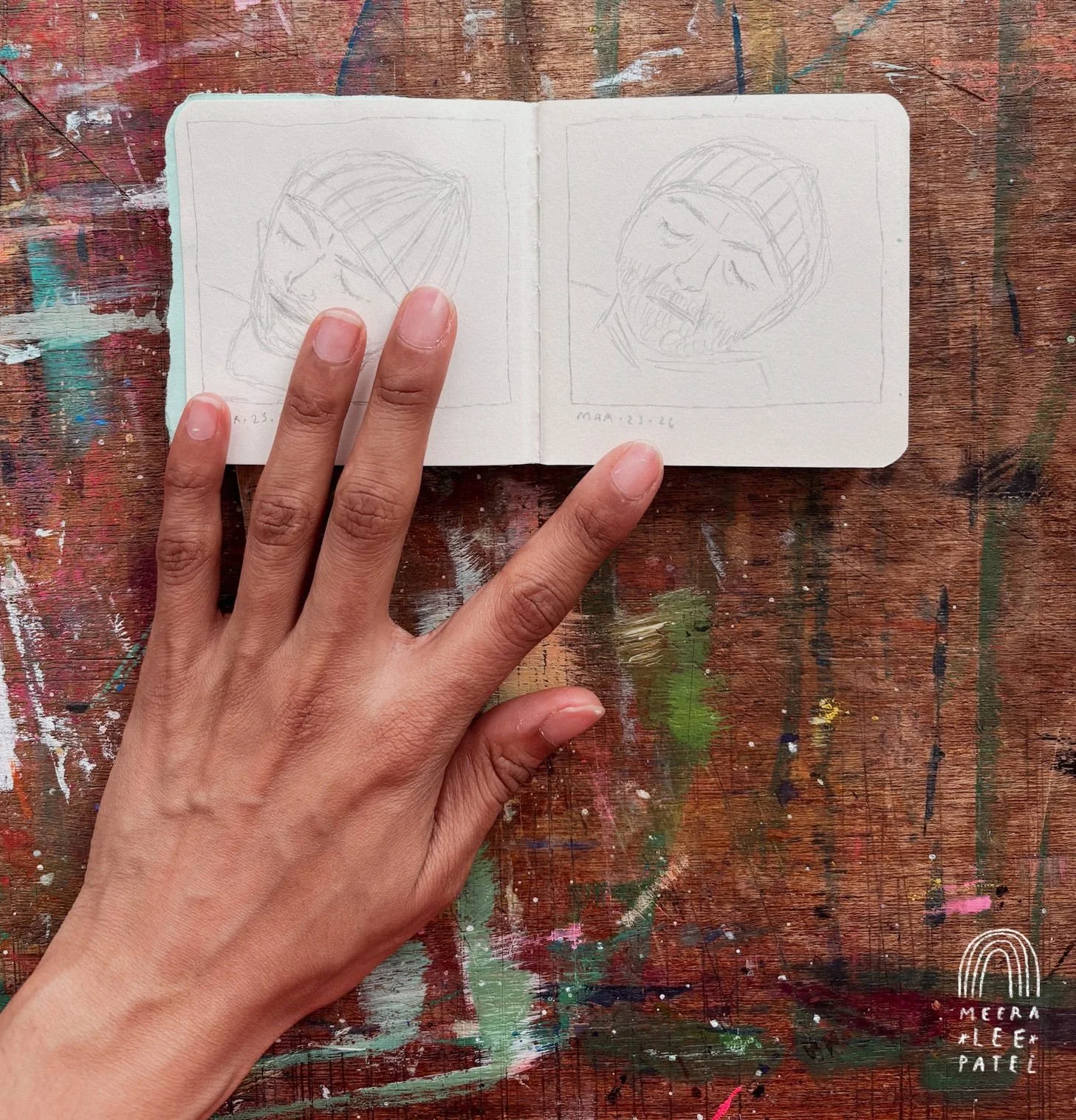
Pops in March (sketchbook, 2026)
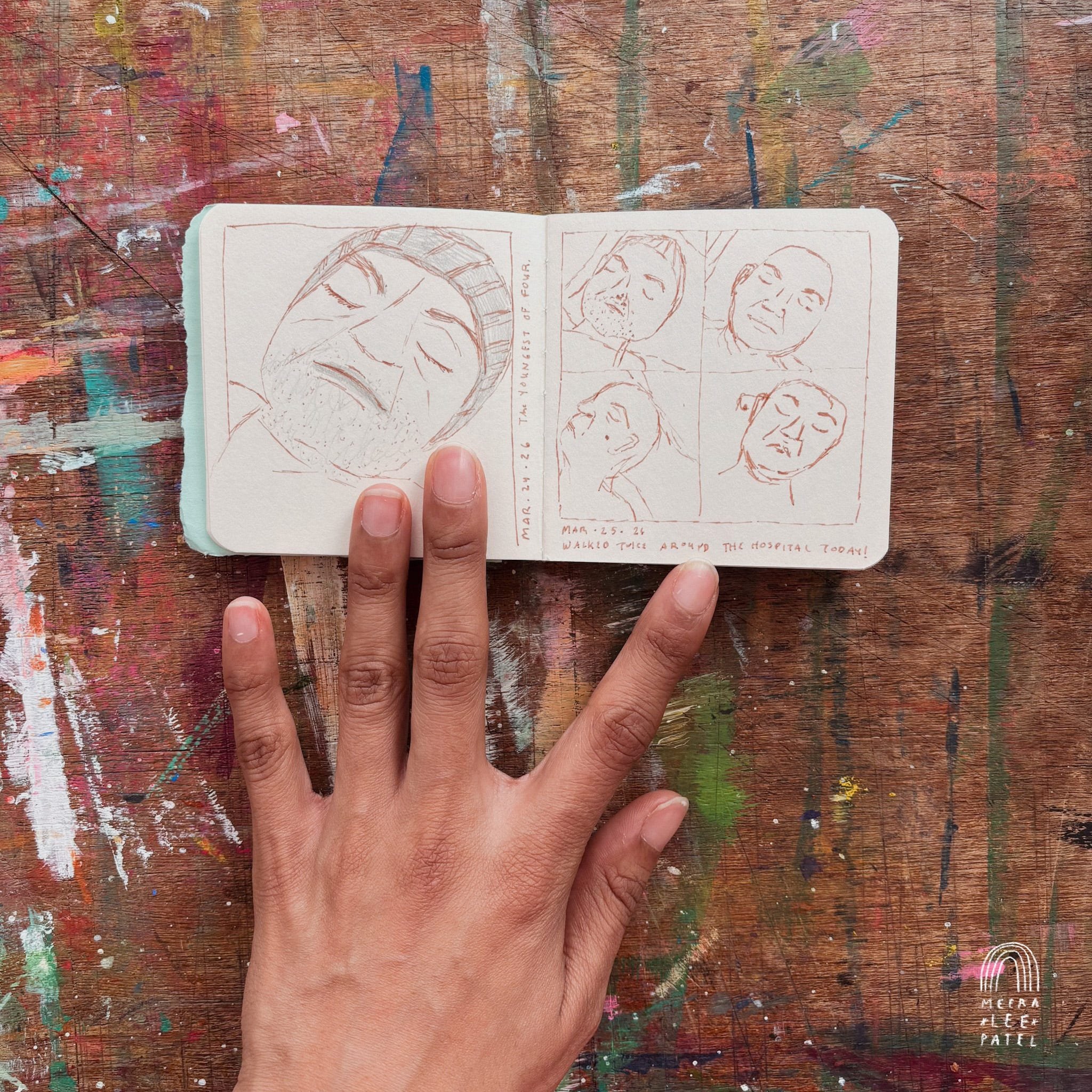
Pops in March (sketchbook, 2026)
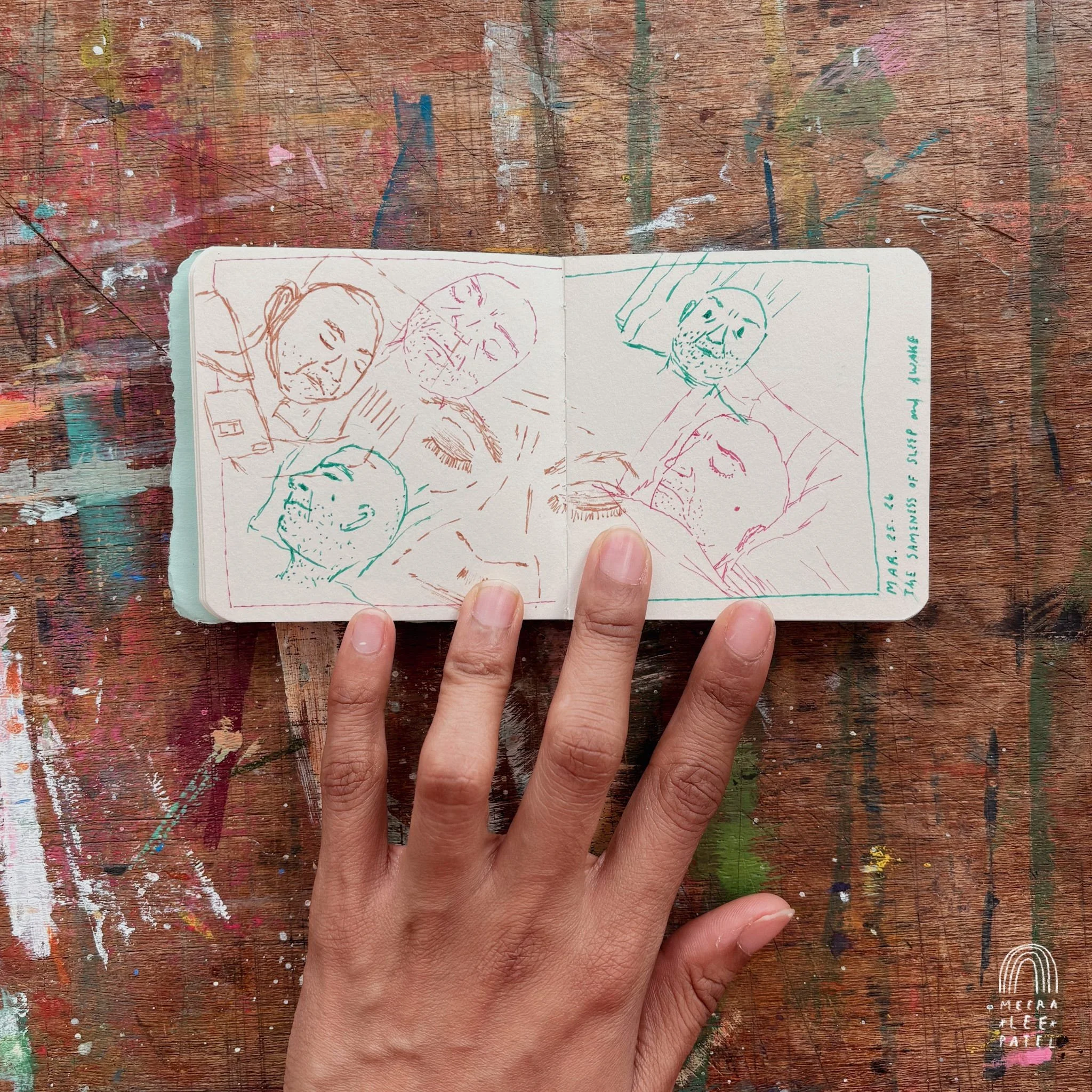
Pops in March (sketchbook, 2026)

I’m no good at capturing likeness, but for once, I don’t let it bother me. I just focus on the moment, the drawing, the memory. Everything changes in time.

WEDNESDAY

I’ve cited this passage in my newsletter before, and I’ve no doubt I will do so again; it is one that I return to repeatedly as the years roll on by:

“Care is like ephemeral art—an Andy Goldsworthy sculpture of mac and cheese and baby wipes and no tears shampoo and socks that never match and chore charts that never work and all that just gets blown away with the winds of time. And like art that isn’t static, isn’t permanent, can’t be put up on a wall and admired in a museum—care is devalued. We stumble on it sometimes in the wild and it takes our breath away, a momentary glimpse of the tenderness with which we hold and protect and nourish and delight in our loved ones; just like one of Goldsworthy’s mandala’s, there’s a divine structure to it, a feeling of inevitability. It’s as ordinary as dirt and as sacred as the kind found at Chimayo. It’s here, there, and everywhere, so kind of nowhere.

Caring for someone you love is, of course, a reward on to itself, the deepest of them, but it need not be labor that happens in such embattled circumstances. It could be absorbed and still revered, invisible and still funded, ephemeral and still prized. It could be held as the center of our existence, rather than the thing we rush through to get to our “real work.” We could see and honor the seasons—caring for children, caring for elders—and the variable capacities—the neurodivergent and disabled and chronically and temporarily ill.

I wish we had policy and professional expectations that mirrored our better angels, which show up again and again and again. Meanwhile, the winds will keep blowing away our beautiful care. That’s okay. That’s as it should be. Most of what is wildly worthwhile is achingly impermanent.”

—from Courtney Martin’s The Art of Care Mostly Disappears

THURSDAY

Some folks’ lives roll easy as a breeze, drifting through a summer night; but most folks’ lives, oh, they stumble, Lord, they fall; some folks’ lives never roll at all. 

FRIDAY

It is a kind of love, is it not?
How the cup holds the tea,
How the chair stands sturdy and foursquare,
How the floor receives the bottoms of shoes
Or toes. How soles of feet know
Where they’re supposed to be.
I’ve been thinking about the patience
Of ordinary things, how clothes
Wait respectfully in closets
And soap dries quietly in the dish,
And towels drink the wet
From the skin of the back.
And the lovely repetition of stairs.
And what is more generous than a window?

—The Patience of Ordinary Things by Pat Schneider

  • Dear Somebody: Tiny joys. (April 4, 2025)

Of all the things you can put in front of your eyes, I’m grateful that my little letter is one of them. 

If you’d like to support me, please buy my books. My art prints and line of greeting cards make excellent gifts for yourself or a friend. You can also hire me for your next project—I’d love to work together. 

xx,
M


To sign up for my weekly newsletter, Dear Somebody, please subscribe here.
In Life, Sketchbook Tags Parents, Life, Pat Schneider, Paul Simon, Courtney Martin, Sketchbook
Comment

Dear Somebody: How to get back up.

December 19, 2025

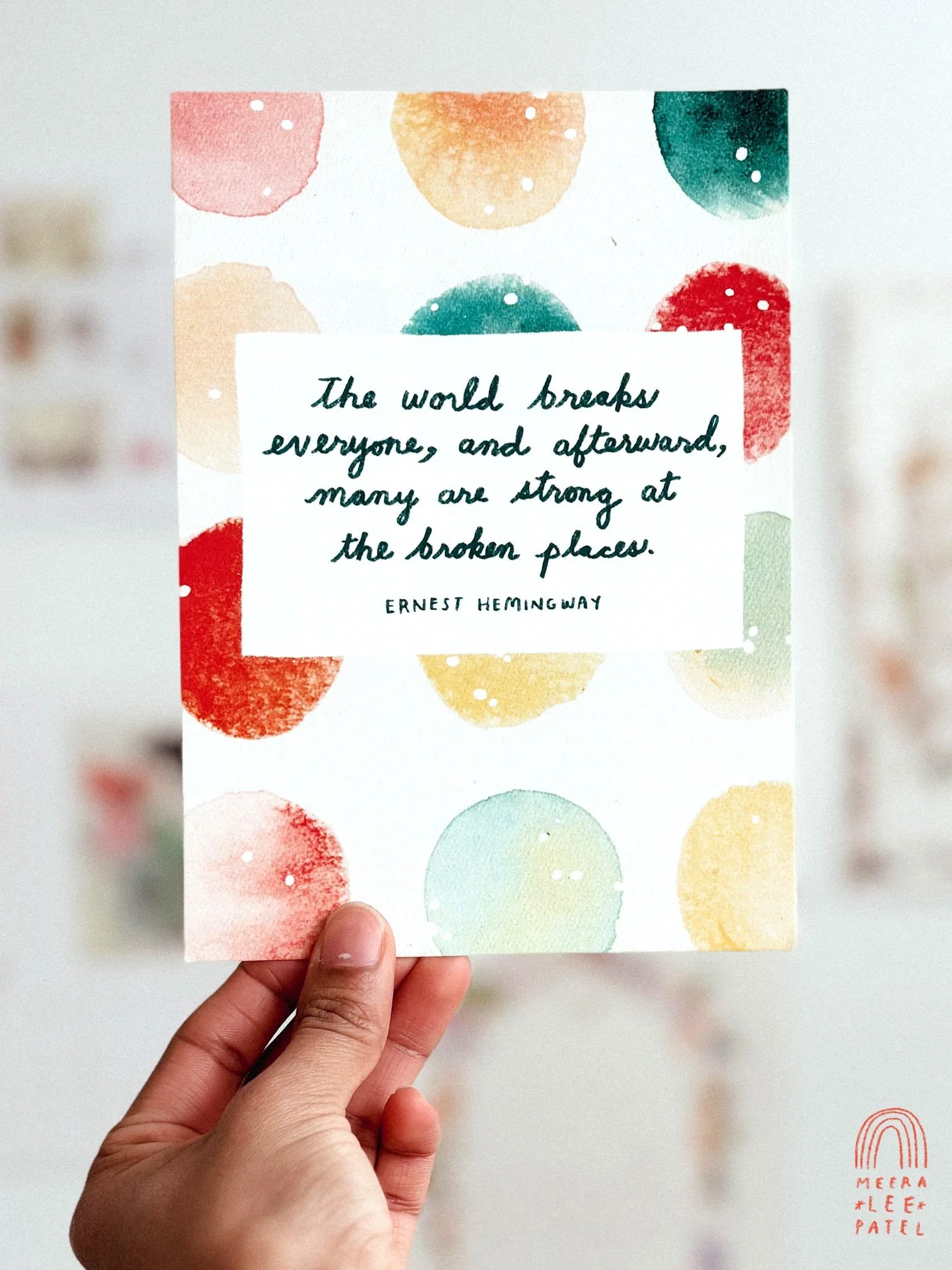
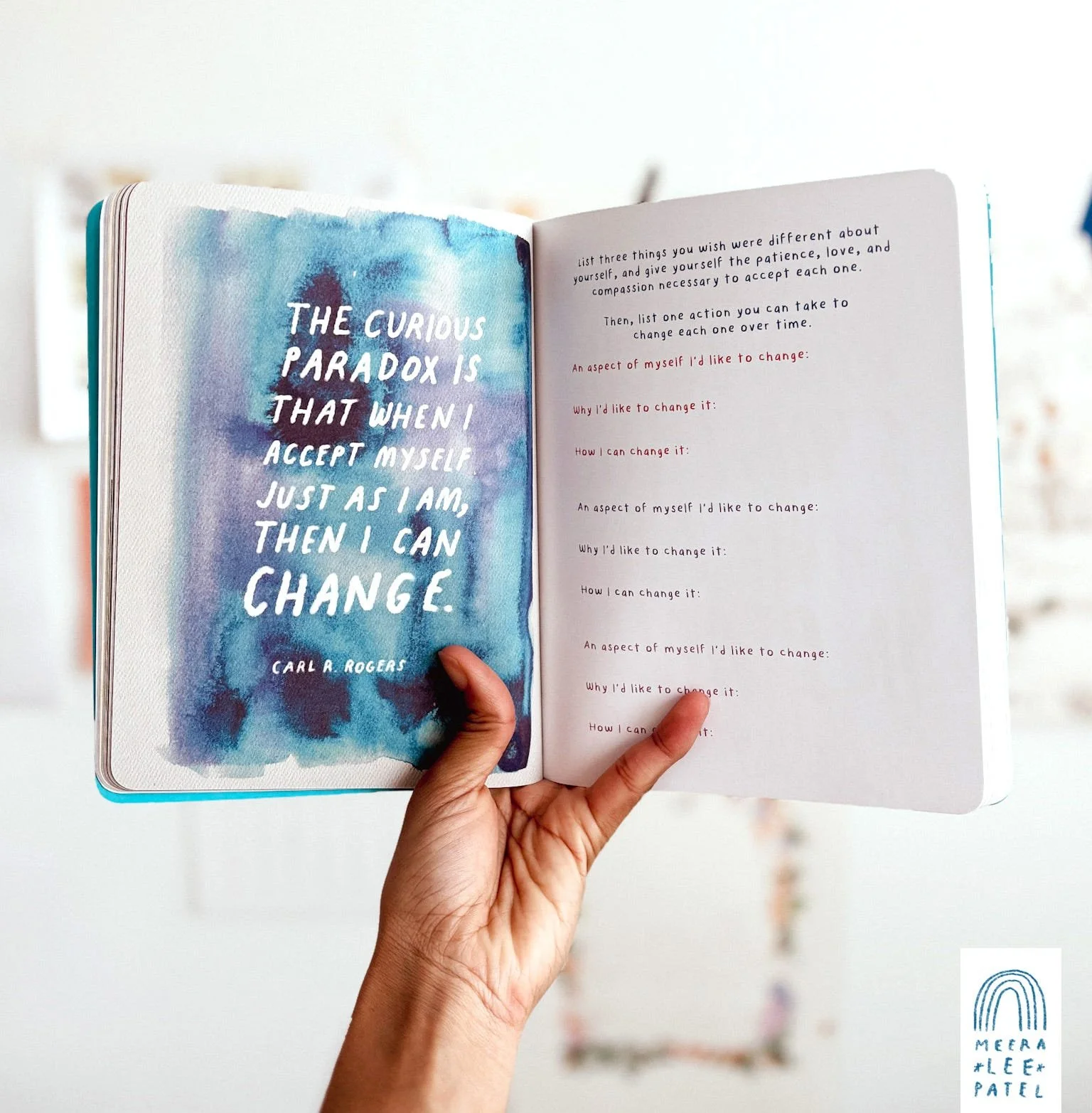
An illustration from LEARN TO LET GO which reads “The world breaks everyone, and afterward, many are strong at the broken places.” —Ernest Hemingway (watercolor, 2025)

A year from now, here are five things from this week that I'd like to remember:

MONDAY 

In the month since I last wrote, I’ve wanted to write: about our trip to Mexico City, the first time T and I have gone anywhere, alone, since having N five years ago. The sights, smells, and sounds of a country so vibrant with culture and opinion and loyalty; how our two children missed us but were loved and cared for by hands that weren’t ours; of the new, incredible rush of knowing I can step outside of my own life without it falling apart. 

In the month since I last wrote, I’ve wanted to write: about K’s visit the first week of November; about our children who are growing to know and think of each other daily, though they are hundreds of miles apart; of a friendship that grows and changes, no longer dependent on daily connection; of friendship that runs on an underground rail line, traveling under arbitrary state lines and handfuls of years spent apart; of friendship that moves forward, steadily, through fallen rock, waste, and insult.

In the month since I last wrote, I’ve wanted to write: about N’s first time seeing The Nutcracker, her eyes lit up by sugar plum fairies and the pure strength of a ballerina; about our Thanksgiving and the best part of N’s day; about F’s desire for everyone to be together, always, smushed inside a giant group hug; about how my two small children seem bigger and bigger each day—the roundness draining from their cheeks, the language falling from their mouths cleaner than Winter herself. 

In the month since I last wrote, I’ve wanted to write. But I haven’t. Instead, like a genealogist, I’ve studied family trees, and how each of us carries what we inherit, including a good amount of rot. I can cut the rot away, if I have what it takes to do the cutting. Like an engineer, I’ve taken myself apart. Like an artist, I’ll put myself back together—not from the ground up, but from pretty far down, without all of the pieces I once thought I needed. 

I want to write more—for you, for myself. In the new year, I hope to. But in case I don’t, I’m writing to remind myself that a full life—one that is truly bursting with adventure and risk and joy, requires a lot of falling down and a lot of getting back up. 

Right now, I’m getting back up. And I’m taking my time. 

TUESDAY

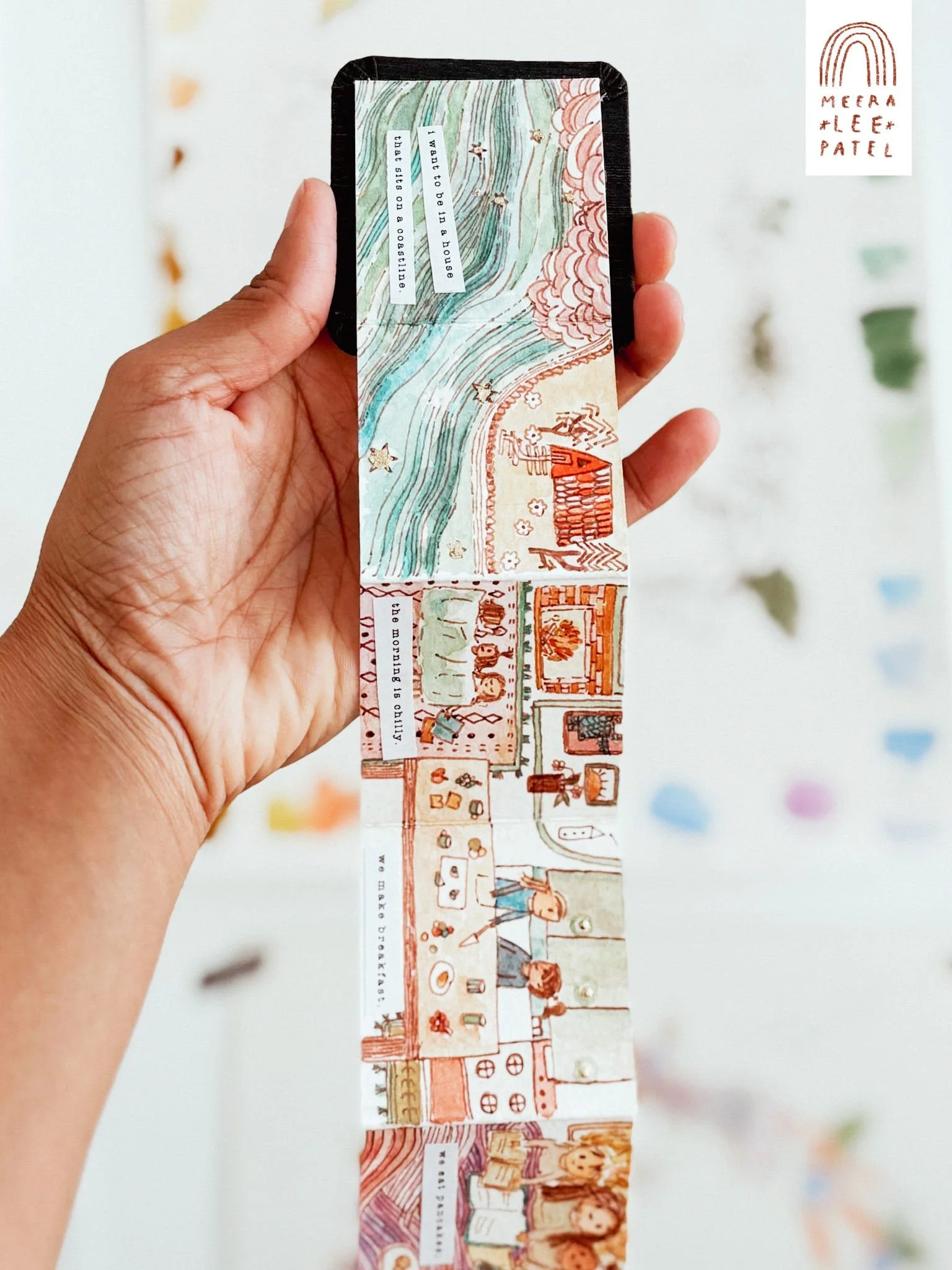
For K’s birthday, I made her a tiny book:

Our House: A Tiny Book (watercolor and ink, 2025)

This was a joyful experience. I want to write a more in-depth process post about the making of this book early next year, but for now, I’ll say that making continues to be the foundation of my joy, hope, and health. The more I focus on the process of making, the less I focus on what I’ve made—and that makes all the difference.

WEDNESDAY

My annual joys include re-reading, watching, and listening to Raymond Briggs’ The Snowman—this year, we added The Bear to our watchlist. I’ve been listening to Elvis’ Christmas Album on repeat and sadly, I love it more and more with each listen. I still like watching the snow come down; I still like turning the space heater on; I still like drawing pictures on cold windows with my fingertips. 


THURSDAY

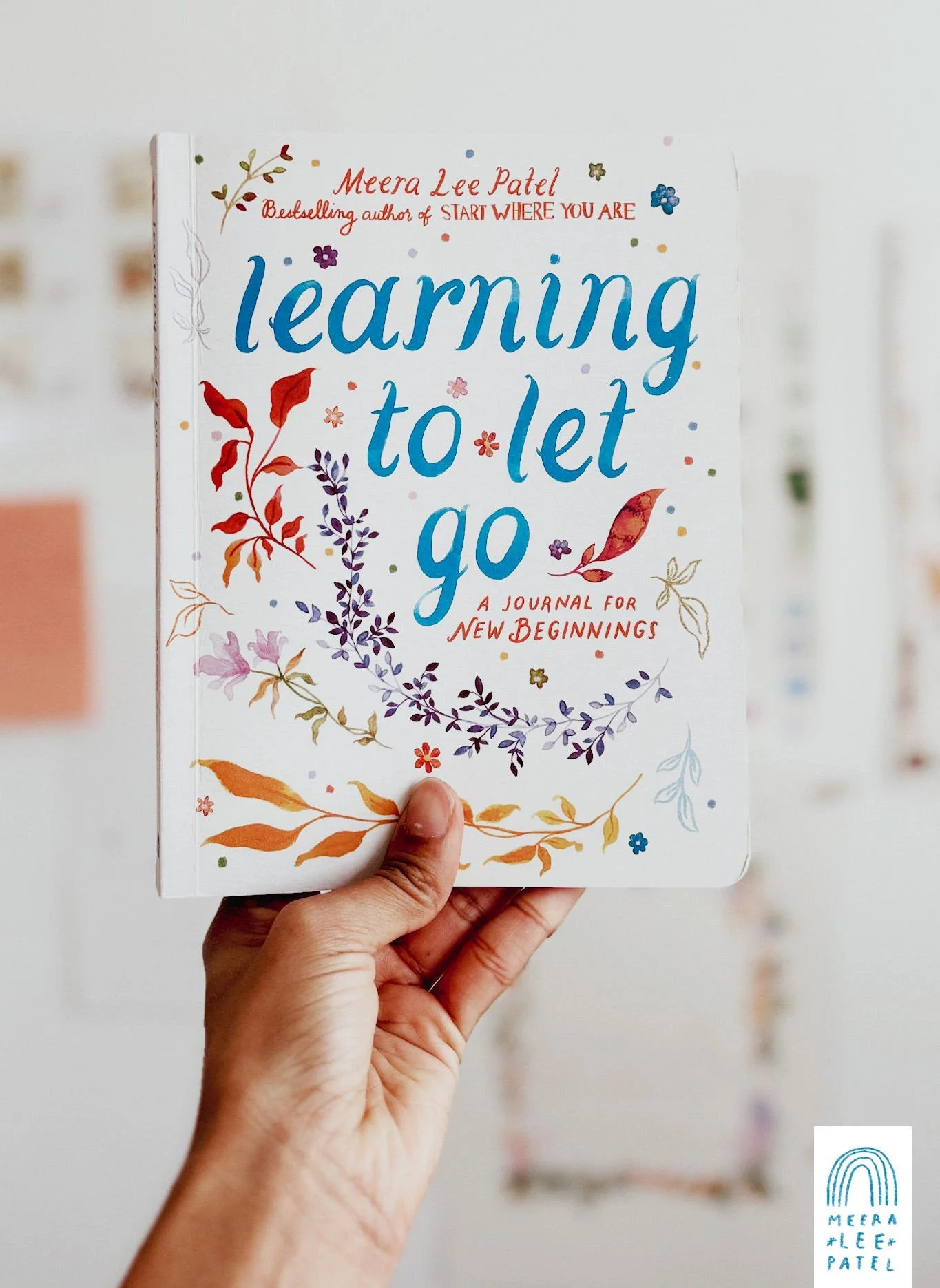
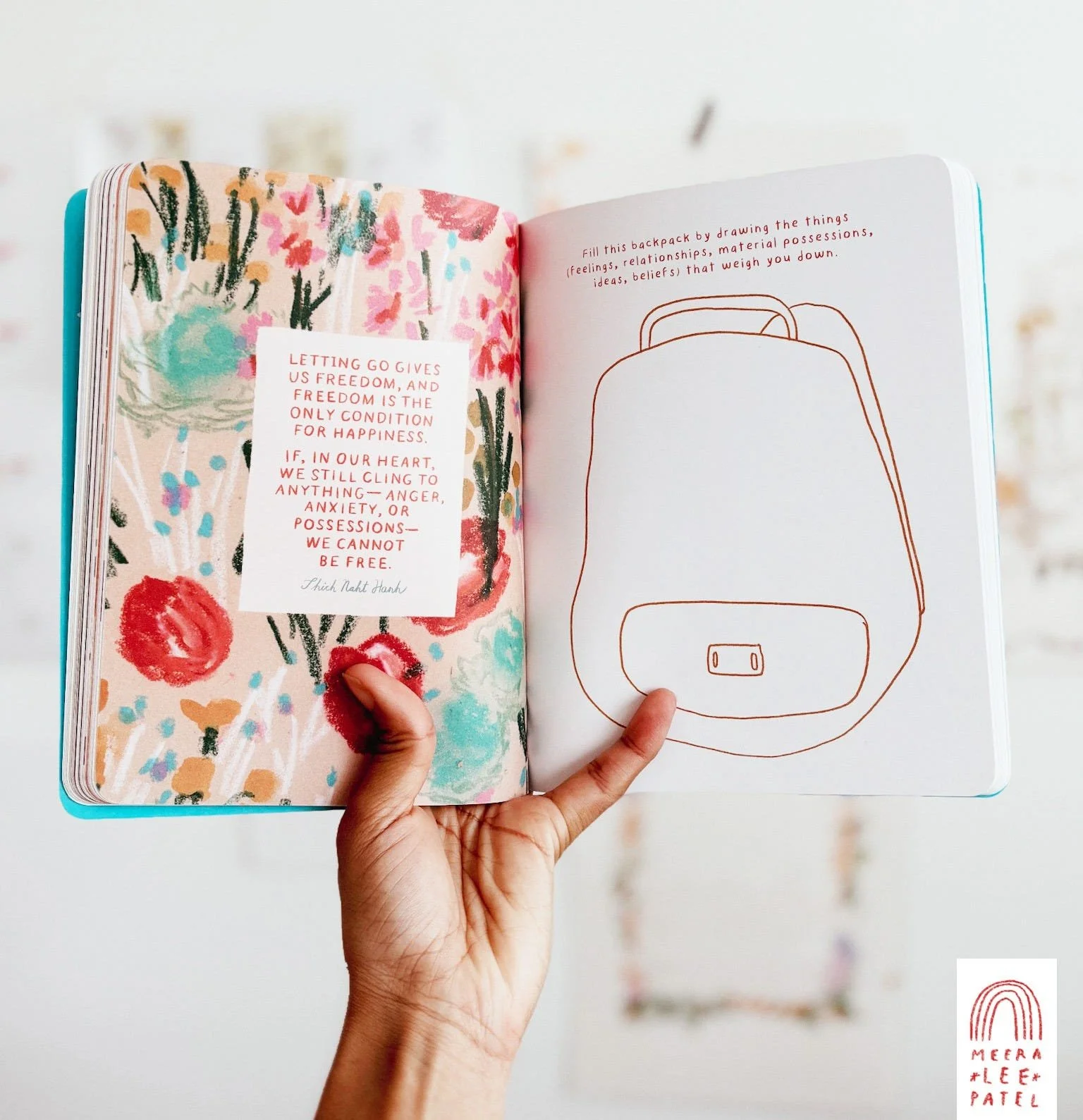
I received a few copies of the UK edition of LEARN TO LET GO, titled LEARNING TO LET GO from my publisher Michael O’Mara, and I’m stunned by how beautiful it is. 

Learning to Let Go, published by Michael O’Mara Books (2025)

Learning to Let Go, published by Michael O’Mara Books (2025)

Learning to Let Go, published by Michael O’Mara Books (2025)

I love the large format, with generous amounts of space for writing, the rounded edges, and the beautiful, thick paper they used. 

If you live overseas and are looking for a thoughtful, encouraging gift for yourself or a friend—I ask you to please consider purchasing a copy of the UK edition. It’s available through numerous outlets: LEARNING TO LET GO (UK EDITION).

For my friends who live here in the United States, please consider purchasing a copy of LEARN TO LET GO (US EDITION) from any of the following locations: 

Amazon, Barnes & Noble, Bookshop.org, Books A Million, BuyOlympia (*includes special limited edition print!), Hudson Booksellers, Target, Walmart.

Please also consider leaving a review so this book can reach more hands and help those who need it most. 

Thank you, always, for supporting my work and for being here. I look forward to writing this newsletter each week (even on the weeks I don’t manage to send one out!) and that’s because of you. <3 

FRIDAY

I am learning to abandon the world
before it can abandon me.
Already I have given up the moon
and snow, closing my shades
against the claims of white.
And the world has taken
my father, my friends.
I have given up melodic lines of hills,
moving to a flat, tuneless landscape.
And every night I give my body up
limb by limb, working upwards
across bone, towards the heart.
But morning comes with small
reprieves of coffee and birdsong.
A tree outside the window
which was simply shadow moments ago
takes back its branches twig
by leafy twig.
And as I take my body back
the sun lays its warm muzzle on my lap
as if to make amends.

—I Am Learning to Abandon the World by Linda Pastan

See you next week!

xx,

M


To sign up for my weekly newsletter, Dear Somebody, please subscribe here.
In Books Tags Learn to Let Go, Linda Pastan, Books, Raymond Briggs, The Bear, Elvis, Parenting, Parents
Comment

Dear Somebody: The Biggest Dream

August 23, 2024

From my illustrated essay, The Biggest Dream, for Chickpea Magazine

A year from now, here are five things from this week that I'd like to remember:


MONDAY

Chickpea Magazine, Issue 38: Ease

An image of my essay, “The Biggest Dream,” for Issue 38 of Chickpea Magazine

An image of my essay, “The Biggest Dream,” for Issue 38 of Chickpea Magazine

For Issue 38: Ease of Chickpea Magazine, I wrote about meal preparation as an act of love and care, especially among immigrant and first-generation families—and in my own, as I’ve known it. 

I think about food like I think about most things: pragmatically. I always liked to eat and cook, but that’s evaporated since becoming a mother. Now, meals feel overwhelming: a neverending physically-and-mentally taxing chore necessary for nourishing my young family. I’ve resented this task for who I believe it asks me to be: a devoted mother who easily slaps together healthy, delicious meals without stress or sweat—not because I don’t want to be this person, but because repeatedly, I’ve failed at actually becoming her. 

I first spoke to Cara, the editor of Chickpea Magazine about this piece because I was interested in exploring the perception of care. A single act of love can communicate a wildly different message to the recipient than the message the giver intended to relay; our culture, environment, and personal histories all factor into how we give, perceive, and receive care. For many first generation children, care is not easy to receive. It takes a good deal of work to crack ourselves open enough to even see that it’s there. 

In this essay, I look back on my last pregnancy, which I carried while finishing my final year of graduate school at Washington University. I explore the inevitable clash of multiple generations and cultures living under one roof; parental love shown through the monotony of meal planning, grocery shopping, meal preparation; and how food saves us in the places where, often, language fails. 

This was also the first time I drew my father, pictured here making granola with N, while me and F (in my belly!) talk to my mom, who is, of course, of course…making chai. 

I grimace, almost daily, about my kitchen: it is small, dim, and feels crowded if there are more than two people in it. The magic of drawing is it allows me to see what my eyes cannot: the walls that opened up to let my family grow; the hundred-year-old bricks that still stand strong; the love and care blooming in this tiny kitchen that is, for now, just the right size.

You can read “The Biggest Dream” in its entirety in Issue 38: Ease of Chickpea Magazine. Many thanks to Cara for the opportunity. 

TUESDAY 

I finished Laurie Frankel’s Family Family, which I loved, and can’t wait to read the rest of her work. I wrote about This is How it Always Is in a previous letter (“Tiny miracles everywhere,” see below) and will read The Atlas of Love next. 

I finished Happiness Falls by Angie Kim and am amazed at how well her brain works. 

I’m also reading Bright Young Women by Jessica Knoll, which I am frightened by and want to put down—but I read on because of Knoll’s sharp, intelligent writing, and the truth it exposes about living as a woman, especially in America.

WEDNESDAY

To be sure, I am a forest, and a night of dark trees: but he who is not afraid of my darkness will find banks full of roses under my cypresses. —Friedrich Nietzsche

THURSDAY

I’m still thinking about these gorgeous sketches by Winsor Kinkade and the art of American illustrator Alan E. Cober, which I only discovered because he did the cover art for this thrifted copy of The Sword in The Stone that I’ve had on my dresser for over a decade.  Illustrator Fatmia Ordinola’s work is lush and makes me feel the way it looks: vibrant, buzzing. 

FRIDAY

Imagine: 
I stop running when I’m tired. Imagine: 
There’s still the month of June. Tell me, 
what op-ed will grant the dead their dying? 
What editor? What red-line? What pocket? 
What earth. What shake. What silence.

—from Hala Alyan’s Naturalized

See you next week,
M


To sign up for my weekly newsletter, Dear Somebody, please subscribe here.
In Life Tags Chickpea Magazine, Cooking, Food, Family, Parents, Parenting, Parenthood, Motherhood, Laurie Frankel, Family Family, Happiness Falls, Angie Kim, Bright Young Women, Jessica Knoll, Friedrich Nietzsche, Nietzsche, Winsor Kinkade, Alan E. Cober, The Sword in The Stone, Fatmia Ordinola, Naturalized, Hala Alyan, Poetry
Comment

Dear Somebody: Our mothers and fathers.

February 17, 2023

Maja, gouache and colored pencil on 16”x20” Arches paper. Currently on view at the Washington University Graduate Center

A year from now, here are five things from this week that I'd like to remember:

MONDAY

Most days after lunch, I go for a walk with my dad. I put on my shoes and coat and wait for him by the door. I’m impatient, feeling like a little kid waiting to be driven to school. Sometimes my dad does drive me to school, just like he did when I was growing up, the only differences being that it’s now 25 years later, I’m in graduate school and married with a kid, and he’s retired. 

I’m in my mid-thirties and he’s nearing 70, so it feels a little silly that my dad still takes care of me. It makes me feel even more childlike than I normally do. I get frustrated when he won’t let me carry a heavy bag home or cautions me against walking too fast. He frequently reminds me of things that are impossible to forget, namely that there’s a baby in my belly and I need to take care of myself. Before dinner he slices guava into pieces, sprinkling each with salt, pepper, cumin, and red chili. We eat them in silence, crunching the seeds.

Most evenings after dinner, I power walk around my parents’ apartment in an effort to lower my blood sugar. I start by the living room window and walk straight into the kitchen, around the tiny dining table replete with folding chairs, past the cabinet filled with dozens of glass jars holding seeds, nuts, and flours, past the couch where T and my mother sit talking or reading the news, and straight back towards the window again. If N has already taken her bath, she joins me. “We’re doing exercise!” she shouts with glee, running faster with each lap, cajoling me to keep up with her. She holds my hand with one hand and her belly with the other, mimicking the way I support the baby swimming inside me while waddling around the cozy apartment. 

These walks are the markers of my days: the one I take alone after breakfast, the one with my dad after lunch, the one with my daughter after dinner. They will come to an end quickly, I know. In a few months, the baby will come, and after that, graduation. My parents will move back home and there will be no more walks with dad—after lunch or at any other point during my days. 

I consider this small sorrow daily, usually while putting on my shoes. And then I wait for my dad by the door. 

TUESDAY

“Care is like ephemeral art—an Andy Goldsworthy sculpture of mac and cheese and baby wipes and no tears shampoo and socks that never match and chore charts that never work and all that just gets blown away with the winds of time. And like art that isn’t static, isn’t permanent, can’t be put up on a wall and admired in a museum—care is devalued. We stumble on it sometimes in the wild and it takes our breath away, a momentary glimpse of the tenderness with which we hold and protect and nourish and delight in our loved ones; just like one of Goldsworthy’s mandala’s, there’s a divine structure to it, a feeling of inevitability. It’s as ordinary as dirt and as sacred as the kind found at Chimayo. It’s here, there, and everywhere, so kind of nowhere.

Caring for someone you love is, of course, a reward on to itself, the deepest of them, but it need not be labor that happens in such embattled circumstances. It could be absorbed and still revered, invisible and still funded, ephemeral and still prized. It could be held as the center of our existence, rather than the thing we rush through to get to our “real work.” We could see and honor the seasons—caring for children, caring for elders—and the variable capacities—the neurodivergent and disabled and chronically and temporarily ill.”

—The art of care mostly disappears from Courtney Martin’s The Examined Family

WEDNESDAY

The perfect way to begin this morning is by listening to the Our House demo with Graham Nash and Joni Mitchell while making N’s lunch and rubbing the sleep from our eyes. 

THURSDAY

We’ve heard a lot about quiet quitting lately, but this post by my friend and artist Lisa Congdon, about loud quitting, really stayed with me. In it, she writes: 

So far in the past 9 months, I’ve quit alcohol, food restrictions, teaching college, my podcast (more on that to come), two boards of directors, working on Fridays, working on umpteen client projects at once, coffee dates with people I don’t know, most public speaking, writing any more books, several friendships, and most weekday evening plans. I have not felt as happy, “balanced” (if such a thing exists) and such a sense of spaciousness in nearly 20 years. 

I’ve begun to think of this as “loud quitting” — intentional, communicated, assertive (as opposed to passive), and unapologetic. So, to be clear, this not necessarily the opposite of “quiet quitting,” which is about not going above and beyond in the workplace (which I also support) — just simply my way of overtly claiming and taking control over my time in a way I haven’t in my entire life — because, for most of my 55 years, I thought it was literally my duty to please/serve others. 

I contributed a comment about my own long string of things I’ve quit this year, and it’s obvious that neither Lisa nor I are the only ones. The past few years have all added up to this one, where we’re rediscovering what our values and boundaries are—and that’s always something worth celebrating. 

FRIDAY

whose influences, we said,
    made us passive and over-polite
whose relationships with our fathers
    we derided at consciousness-raising groups
whose embroidered pillowcases still accuse us
    on the shelves of our modern lives

they have become interesting old women
they are too busy to write often
they wish we wouldn't worry about them
they are firm about babysitting
they are turning out okay

—Our Mothers by Leona Gom

If you'd like to support me, you can pre-order my upcoming book of illustrated essays, How it Feels to Find Yourself, for yourself, a loved one, or both! My art prints, stationery, and books are available through BuyOlympia. You can also pledge your support for this newsletter by becoming a future paid subscriber. 

xx,

M


To sign up for my weekly newsletter, Dear Somebody, please subscribe here.
In Life Tags Graduate School, Parents, Walking, Andy Goldsworthy, Caring, Love, Courtney Martin, The Examined Family, Graham Nash, Joni Mitchell, Our House, Quiet Quitting, Lisa Congdon, Balance, Leona Gom, Our Mothers
Comment

Dear Somebody: Another year over.

April 22, 2022

A portrait of my mother and N, for Issue #53 of Uppercase Magazine

A year from now, here are five things from this week that I'd like to remember:

MONDAY

When my mother first comes to visit me on the farm, she’s in awe. She’s lived in the suburbs for her entire adult life, ever since she emigrated to the United States as a young woman. For the last 30 years, she’s been surrounded by streets and sidewalks, the chatter of neighbors, the early morning rumble of school buses picking up their children. Here, it’s quiet.

"Look at all this land!” she says, walking around the 20 acres of wood that surrounds us. “Wow. It’s so green. So beautiful. Look! There’s deer there.” I look, but my eyes miss their delicate limbs as they disappear into the maple trees. Instead, I see the weeds inching past my knees, the stone driveway in need of leveling, the demolished kitchen I spend my days re-tiling. We wash our dishes in the bathtub. We spend our nights tilling the earth, weeding the greenhouse, or clearing years of neglect from the yard. It’s difficult for me to imagine the future, but I know it will take many years to love this neglected land into something new.

–An excerpt from my latest column, Being, for Issue #53 of Uppercase Magazine

TUESDAY

"To be reminded of your cosmic insignificance therefore isn't just relaxing, but actively empowering. Because once you remember the stakes aren't anywhere near that high, you're free to take meaningful risks, to let unimportant things slide, and to let other people deal with how they might feel about your failing to live up to their expectations."

–Oliver Burkeman on Cosmic Insignificance

WEDNESDAY

Today, on my birthday: this is what I look like. This is what I look like nearly all of the time: like I'm sleepwalking through life.

I've got one year of graduate school nearly finished, one forthcoming book of essays written and under my editor's care, and one beautiful baby who loves waking up at 4am.

Sometimes I look at my little family and feel like I'm in a dream. Sometimes I get off the phone with a friend and I think about how lucky I am to have such meaningful relationships. I've built a life my 15-year-old-self couldn't even have imagined. I feel myself changing nearly all of the time. Things are hard and beautiful; challenging and all the more fulfilling because of that.

Low on sleep, but life is full, full, full: this is a lucky life.

THURSDAY

Over the past half-year, slowness has settled into me. I've become a lot more comfortable with taking the long road, letting go of ideas that dictate where I shouldbe and how it should look.

It is especially difficult to be patient with creative work, which can be quite isolating and lonely, and which relies on a strong connection with your honest, artistic self. I'm continuously rebuilding this relationship. While I do so, interviews with those I admire have been especially comforting: Shaun Tan on taking the long road, Caver Zhang on gradual acceptance, and Lois Lowry on reading as a rehearsal for life.

FRIDAY

Lucky Life isn't one long string of horrors
and there are moments of peace and of pleasure as I lie in between the blows.
Lucky I don't have to wake up in Philipsburg, New Jersey,
on the hill overlooking Union Square or the hill overlooking
Kuebler Brewery or the hill overlooking S.S. Philip and James
but have my own hills and my own vistas to come back to.

Dear waves, what will you do for me this year?
Will you drown out my scream?
Will you let me rise through the fog?
Will you fill me with that old salt feeling?
Will you let me take my long steps in the cold sand?
Will you let me lie on the white bedspread and study 
the black clouds with the blue holes in them?
Will you let me see the rusty trees and the old monoplanes one more year?
Will you still let me draw my sacred figures 
and move the kites and the birds around with my dark mind?

Lucky life is like this. Lucky there is an ocean to come to.
Lucky you can judge yourself in this water.
Lucky the waves are cold enough to wash out the meanness.
Lucky you can be purified over and over again.
Lucky there is the same cleanliness for everyone.
Lucky life is like that. Lucky life. Oh lucky life.
Oh lucky lucky life. Lucky life.

–from Gerald Stern's Lucky Life

xo,

M


To sign up for my weekly newsletter, Dear Somebody, please subscribe here.
In Process Tags Parents, Uppercase Magazine, Oliver Burkeman, Birthday, Family, Shaun Tan, Caver Zhang, Lois Lowry, Gerald Stern, Poetry
Comment

Meera Lee Patel is an artist, writer, and book maker. Her books have sold over one million copies, and been translated into over a dozen languages worldwide.

Her newsletter, Dear Somebody, is a short weekly note chronicling five things worth remembering, including a look into her process, reflections on motherhood, and creative inspiration.

Join thousands of other readers by subscribing.


Latest Posts

Featured
Apr 10, 2026
Dear Somebody: The hard work of it makes me shine.
Apr 10, 2026
Apr 10, 2026
Apr 3, 2026
Dear Somebody: A thousand years.
Apr 3, 2026
Apr 3, 2026
Mar 6, 2026
Dear Somebody: On giving up.
Mar 6, 2026
Mar 6, 2026
Feb 20, 2026
Dear Somebody: A monster inside the wall.
Feb 20, 2026
Feb 20, 2026
Jan 30, 2026
Dear Somebody: More Than Machine.
Jan 30, 2026
Jan 30, 2026

categories

  • Books 12
  • Life 62
  • Motherhood 11
  • Picture Book 1
  • Process 31
  • Sketchbook 12
  • Writing 4
Full archive
  • April 2026 2
  • March 2026 1
  • February 2026 1
  • January 2026 3
  • December 2025 1
  • November 2025 1
  • October 2025 4
  • September 2025 3
  • August 2025 1
  • July 2025 1
  • June 2025 3
  • May 2025 3
  • April 2025 4
  • March 2025 1
  • February 2025 2
  • January 2025 3
  • December 2024 2
  • November 2024 2
  • October 2024 2
  • September 2024 3
  • August 2024 2
  • July 2024 2
  • June 2024 2
  • May 2024 3
  • April 2024 2
  • March 2024 4
  • February 2024 4
  • January 2024 3
  • December 2023 2
  • November 2023 2
  • October 2023 4
  • September 2023 5
  • July 2023 2
  • June 2023 2
  • May 2023 3
  • April 2023 2
  • March 2023 4
  • February 2023 3
  • January 2023 4
  • December 2022 2
  • November 2022 1
  • August 2022 1
  • July 2022 2
  • May 2022 2
  • April 2022 2
  • March 2022 1
  • January 2021 1

READ MY BOOKS


Copyright © 2023 Meera Lee Patel