• Learn to Let Go
  • Books for Everyone
  • Work
  • newsletter
  • Journal
  • Shop
  • About
Menu

Meera Lee Patel

ARTIST, WRITER, BOOK MAKER
  • Learn to Let Go
  • Books for Everyone
  • Work
  • newsletter
  • Journal
  • Shop
  • About

Dear Somebody: When all is quiet.

June 20, 2025

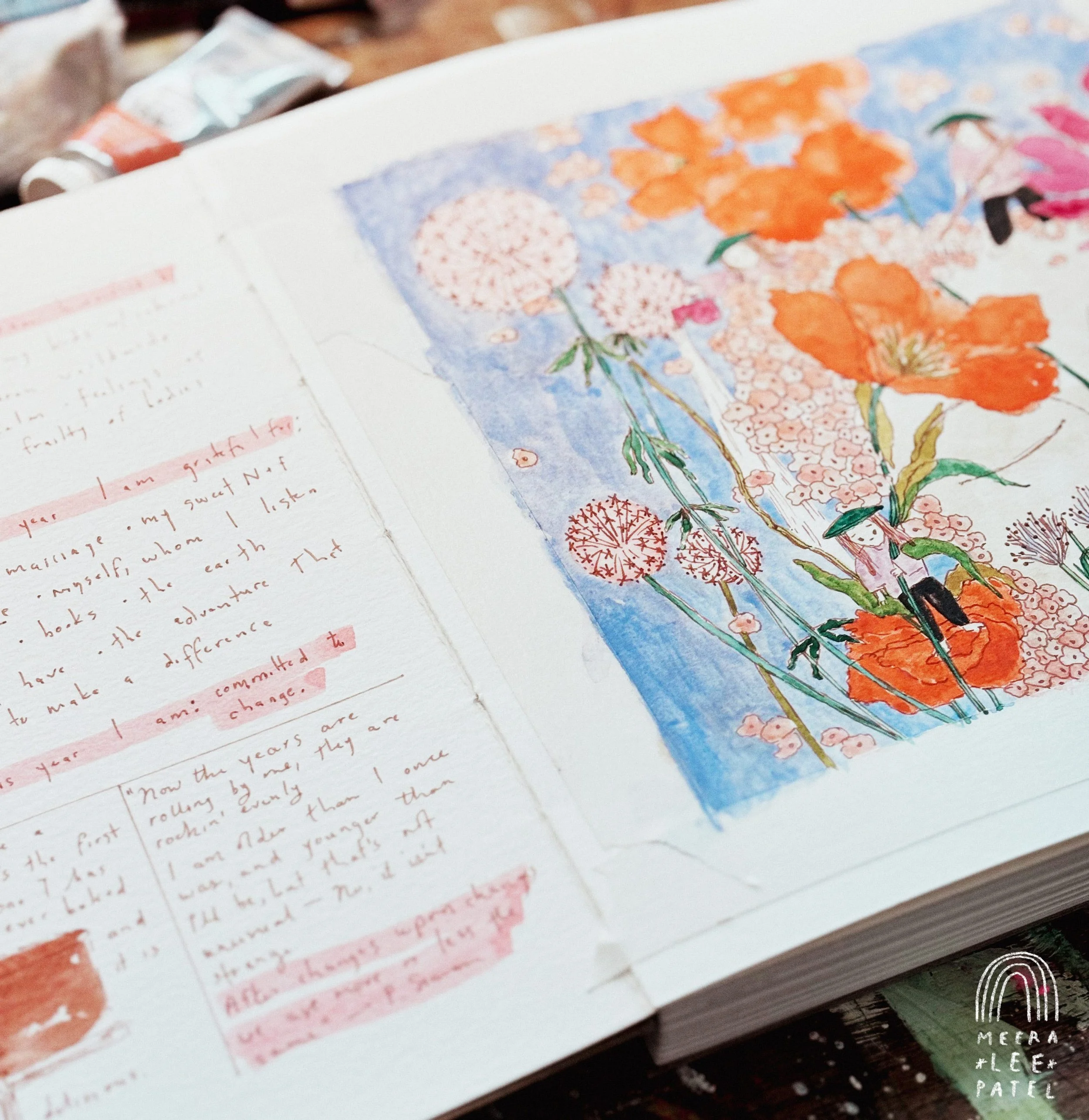
A recent sketchbook page (watercolor and ink, 2025)

A year from now, here are five things from this week that I'd like to remember:

MONDAY 

I sit on the front porch eating a sandwich slapped together with whatever is left in the fridge. I need to go grocery shopping, I need to unpack my kids’ summer clothes, I need to clean the kitchen, I need to take a shower. I’ve been working nonstop towards my current picture book deadline. I’m rewriting a manuscript I care deeply about, I have a new journal coming out this fall, I’ve begun strength training. This fall, I’m determined to learn how to sew. There is so much I want to make, but I am so slow. One day flickers into the next, and then the next, and still, it feels like I’m going nowhere.

My friend Dan Blank calls me to catch up. I confess, with embarrassment, that I don’t have very much to share: life is quiet, almost entirely consumed by my young children, and work is, too. It’s been a few years since I’ve quit the game of social media, and my world feels much smaller because of it. Quieter. I don’t receive many work inquiries because I don’t share as much online. No one can hire you if they don’t know you exist, I tell myself before emailing editors and art directors to remind them. I hold my breath and wait; I listen to the familiar song of crickets. Everyone I know is worried about work, so when my ego flares up in front of me, I stamp it out. As any artist knows, the ongoing quiet can feel suffocating. It plays tricks on you, messing with your sense of worth. It causes you to lose sight of what’s important. It is strong enough to crush your spirit. 

When I hang up the phone, I sit still, sifting through this quiet. I feel ashamed of my embarrassment, for several reasons I can’t separate, quite possibly because there is no separating them. Continuing my career at the same pace, with the same fervor postpartum was simply not a viable option for me. I made conscious decisions to restructure my career and life in a way that made healthier, more meaningful sense. Yet, at times, I feel shame for not barreling ahead at the same pace—for not being able to, for not wanting to, for not wringing myself out in order to simply keep going. Though I know it’s a symptom of the culture we live in, occasionally, I still feel shame for how much I’ve changed. 

Though lonely, the past few years have been good for my brain. Instead of documenting every step of my process for social media, I sink into my craft, remembering why this is the life I chose for myself. I’ve grown and solidified. I am more capable, I require less from others. And inside me, life continues to hum steadily. Joyfully. I feel far more grounded in my creative values. I’m proud of the work I make, however slow the progress is. I’m more present with my children, who, for now, still believe that their inherent worth isn’t dependent on what or how much they produce. I’m beginning to believe I’m a good mother. 

On the other side of worry, I divert my energy towards developing a trust between myself, my work, and the world: things will work out. I can move towards my goals andbelieve they will be achieved. I can build creative growth and hope. I can feel forgotten and be excited to one day reemerge. I can choose to feel good—and the more I do, the more meaningful my subsequent choices are.

Back on the porch, I chew slowly. A small breeze comes along and my napkin flutters, a thin pair of two-ply wings. The tulip poplar tree across from our front yard has grown so large in the few years I’ve lived here. Now, green leaves burst forth, invigorated by our recent rains. The branches stretch towards me like the future does, like the past used to before I closed the door on it. In a few hours, my kids will thunder down these sidewalks, begging me to jump rope with them. We’ll walk down to the nearby bridge, press our faces through the windows in the cement walls, and wait for the city trains to rush by. It doesn’t matter if the conductor looks up or not; we always wave.

On this street lined with grandparents, grandchildren, and shiny blue grackles, there isn’t a single soul who cares what I look like or what my next achievement is, including me. I love living on this street instead of on social media, so I give myself over to the silence. I am grateful for my sandwich, the porch I sit on, and every small, quiet breeze.

TUESDAY

“In its simplest form, a whale’s death becomes a source of life for years beyond its time. It is a transformation that turns death into life on an almost incomprehensible scale. Beyond its biological importance, the concept of a whale fall also holds a poetic significance. It reflects themes of loss and renewal, reminding us that even in its most tragic forms, what’s happened in the past can sustain life in the present in ways we are only beginning to understand.

This haunting question reframed my understanding of land and sea as intertwined repositories of history. The ocean, like the soil, bears witness to lives lost and transformed. It warranted asking: What happens to our bodies, to their essence, when they are claimed by the ocean? How do we reconcile the ocean as both a site of loss and a source of life?”

—Omnia Said on contemporary American artist Ellen Gallagher’s Accidental Records series in Atmos

WEDNESDAY

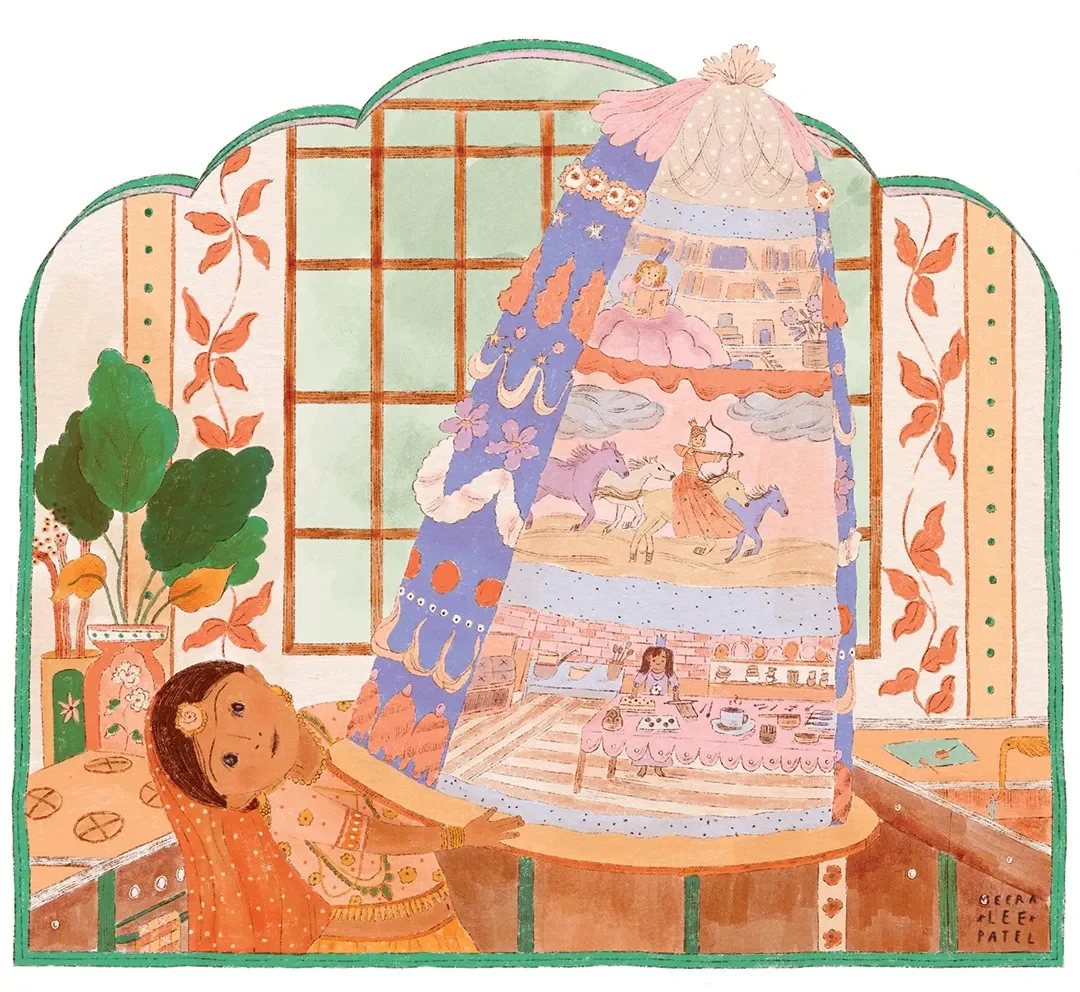
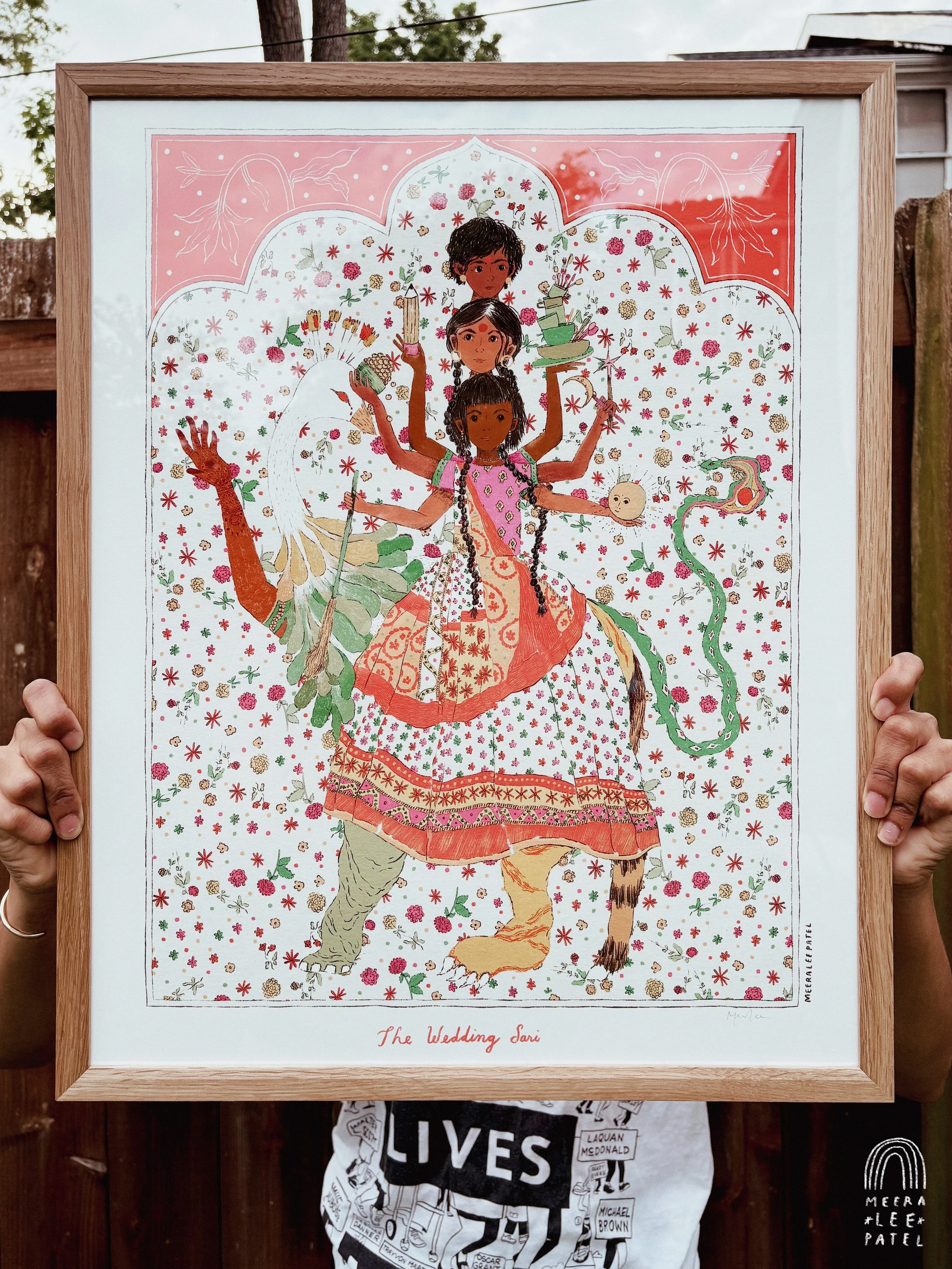
The extremely unassuming frame I ordered for The Wedding Sari finally came, so I framed this piece and am shipping it to my aunt this week. The Wedding Sari is an essay and illustration I created for my column, Being, in Issue #65 of Uppercase Magazine. It explores the history of the Gujarati panetar, or wedding sari, and the one I wore on my wedding day, which was previously also worn by my mother and her older sister, my aunt.

Three prints of this piece exist: one hangs in my home, one hangs in my mother’s home, and now, one is somewhere on its way to my aunt’s. An excerpt of my column was included in a past letter. 

THURSDAY

I’m reading: Long Way Down by Jason Reynolds, an excellent novel-in-verse about the choices we make and the choices we’re taught to make; I finished listening to Solito by Javier Zamora, a heartbreaking tale of a young child’s migration to the States; I began The One and Only Ivan by Katherine Applegate; I began My Friends by Hisham Matar. 


FRIDAY

Now we will count to twelve
and we will all keep still
for once on the face of the earth,
let’s not speak in any language;
let’s stop for a second,
and not move our arms so much.

It would be an exotic moment
without rush, without engines;
we would all be together
in a sudden strangeness.

Fishermen in the cold sea
would not harm whales
and the man gathering salt
would not look at his hurt hands.

Those who prepare green wars,
wars with gas, wars with fire,
victories with no survivors,
would put on clean clothes
and walk about with their brothers
in the shade, doing nothing.

What I want should not be confused
with total inactivity.
Life is what it is about;
I want no truck with death.

If we were not so single-minded
about keeping our lives moving,
and for once could do nothing,
perhaps a huge silence
might interrupt this sadness
of never understanding ourselves
and of threatening ourselves with death.
Perhaps the earth can teach us
as when everything seems dead
and later proves to be alive.

Now I’ll count up to twelve
and you keep quiet and I will go.

—Keeping Quiet by Pablo Neruda

See you next week!

xx,

M


To sign up for my weekly newsletter, Dear Somebody, please subscribe here.
In Sketchbook, Process Tags Sketchbook, Dan Blank, Process, Ellen Gallagher, Uppercase Magazine, Jason Reynolds, Javier Zamora, Katherine Applegate, Hisham Matar, Pablo Neruda
Comment

Dear Somebody: Being here.

April 12, 2024

An illustration for my column, Being, in Issue #61 of Uppercase Magazine

A year from now, here are five things from this week that I'd like to remember:

MONDAY 

When T pulls handfuls of weeds away from our hydrangea bushes, we discover a mourning dove sitting quietly, her back against the brick of our house. T stops pulling weeds; N stops eating; I stop talking. Is she nesting? Is she hurt? How can we help? We didn’t mean to expose her, but we have. We go inside. From the window I watch her two small eyes blinking in the sun. 

When F contracts an illness, I know the week ahead will be gutted, and it is. The sitter is canceled, my work is placed on hold indefinitely. The deadlines pile up, as does the laundry, the dust. My inbox groans; my daily poem practice falls further behind.

I don’t optimize. It doesn’t make sense anymore. In the past, I have worried, having convinced myself that worrying is doing something and therefore, at least, still productive. Of course, I was wrong; each day, I continue to be. If there’s a purpose to life, maybe this is it—to constantly unlearn until, at the end, I am stripped of all belief, leaving the way I came in: honest, unharmed, full of possibility. 

I don’t optimize. I have worked too hard at letting go. There are no to-do lists in my head. I don’t write poems while F takes her bottle, I don’t clean the house while she eats oatmeal. I spend time leisurely, as if I have boatloads of it, as if someone out there is making more of it for me. We sit outside and listen to the world. I ask F if she remembers the eclipse and the way the sky moved like a movie. She wails in response. She cries a lot. She coughs a lot. I sit with her and together, we do nothing. I am here. 

More than once, she crawls into my lap, buries her face in my shirt, and falls asleep. I wish I had my phone, I think to myself, so I could do something. Old habits die hard, but I recognize the impulse, however warily. I don’t retrieve my phone. Instead, I do what I am doing: I sit on the second-floor landing and rub F’s back with my hands, staring at our hallway walls. I am here. 

I rock F to sleep, something I haven’t done for the past 8 months, and in this act, she feels like a baby in my arms once more. I admit, I am nostalgic. Maybe it’s because she’s turning one next week, maybe it’s because I am turning decades older than that. Maybe it’s because there is no match for a moment sweeter than this one, where a child sleeps safely in my arms. Maybe it’s because there’s safety in these moments for me, too. I am here. From above I watch her two small eyes blinking with sleep.

TUESDAY

I read Go to Sleep (I Miss You) and Kid Gloves by Lucy Knisley; I read Tokyo These Days by Taiyo Matsumoto (that cover!); I started Sunny by Jason Reynolds. I am re-reading James Marshall’s eulogy for Arnold Lobel, one of my favorite children’s writers and illustrators, and a fellow devotee of friendship. 

WEDNESDAY

For my latest Being column in Issue #61 of Uppercase Magazine, I wrote about how the themes in our creative work change shape and expand, evolving as we do, but ultimately remain the same—they are fragments of our foundational selves that we will always explore. 

View fullsize 8b76b8cb-8683-406b-9c16-a7650d011ce3_3024x3669.jpg
View fullsize afc36173-569d-4e92-b554-66b323e382c8_3024x4032.jpg
View fullsize fe2d244f-7a05-4744-aad2-1d5a27b49236_3024x4032.jpg

I touch on the importance of revisiting past work, even if it’s difficult to do so: 

“Revisiting old work is clarifying. It brings you closer to the person you were at that time—the person who felt pulled to capture a feeling, thought, or question through their art. It’s also a chance to notice how much you and your work have changed—a chance to acknowledge the creative obstacles you’ve puzzled through and the personal ones your artmaking pulled you through.”

—from The First Work I Make is the Last Work I Make for Uppercase Magazine #61, available now. 

THURSDAY

Today, it was pointed out to me that my emotional vocabulary is pretty limited(!). I was both bowled over and energized by this comment. I’ve spent the past decade helping others identify and process their own emotions, only to quietly realize that my knowledge has plateaued. I am humbled and, quite honestly, enthused by how far there is to go.

I am reading How Emotions Are Made: The Secret Life of the Brain by Lisa Feldman Barrett in an immediate effort to remedy my own cause. I welcome further reading! If you have a book recommendation, please do share.

FRIDAY

Years do odd things to identity.
What does it mean to say
I am that child in the photograph
at Kishamish in 1935?
Might as well say I am the shadow
of a leaf of the acacia tree
felled seventy years ago
moving on the page the child reads.
Might as well say I am the words she read
or the words I wrote in other years,
flicker of shade and sunlight
as the wind moves through the leaves.

—from Leaves by Ursula K. Le Guin

xx,
M


To sign up for my weekly newsletter, Dear Somebody, please subscribe here.
In Life Tags Motherhood, Parenting, Parenthood, Go to Sleep (I Miss You), Kid Gloves, Lucy Knisley, Tokyo These Days, Taiyo Matsumoto, Sunny, Jason Reynolds, James Marshall, Arnold Lobel, Illustration, Friendship, Reading, Uppercase Magazine, The First Work I Make is the Last Work I Make, Writing, How Emotions Are Made, The Secret Life of the Brain, Lisa Feldman Barrett, Ursula K. Le Guin, Leaves, Poetry
Comment

Dear Somebody: Holding onto the proof.

April 1, 2022

A year from now, here are five things from this week that I'd like to remember:

MONDAY

The past few weeks have been a series of can-we-make-it-to-the-next-day? days. Days full of class-and-homework, my looming book deadline, and the last dregs of winter; weeks that all seem the same.

I sit on the edge of our bed talking to T, whose eyes are worn with sickness. We have food poisoning, and it's the first time we've both been sick, at the same time, since having N. I rake the carpet with my toes, listening to her shout No! over and over again, her tiny voice permeating through the walls and ringing in my ears. She should've been asleep a long time ago. This weekend has been hard. I am tired. But something in me feels new.

Somewhere between the hours of school and hours of work, between the food poisoning and the exhaustion, between the constant cleaning and meal-planning and piles of neglected laundry, I'd found the proof. I didn't even know I was looking for it, but here it was, hanging in the mundanity: proof of a life well-lived.

Even the most disappointing of experiences hold meaning. I try to remember that even though I'm not always successful. But when I stop rushing through them to get to the “good” part of life, the value is too great to miss. The good part is here––in the illness, the deadlines, and the round, giddy baby who watched an entire hour of Daniel Tiger while her mother lay, utterly exhausted, beside her.

The good part is here: I'm holding onto the proof.

TUESDAY

"But how does one keep an imagination fresh in a world that works double-time to suck it away? How does one keep an imagination firing off when we live in a nation that is constantly vacuuming it from them? And I think that the answer is, one must live a curious life. One must have stacks and stacks and stacks of books on the inside of their bodies. And those books don’t have to be the things that you’ve read. I mean, that’s good, too, but those books could be the conversations that you’ve had with your friends that are unlike the conversations you were having last week. It could be about this time taking the long way home and seeing what’s around you that you’ve never seen, because most of us, especially city folk, we stay in our little quadrants.

But what if you were to walk the other way? What if you were to explore the places around you? What if you were to speak to your neighbor and to figure out how to strike a conversation with a person you’ve never met? What if you were to try to walk into a situation, free of preconceived notion, just once? Once a day, just walk in and say, “I don’t know what’s going to happen, and let’s see. Let me give this person the benefit of the doubt — to be a human.” ––Jason Reynolds on Imagination and Fortitude (via On Being)

*For those with pre-teens, I recently listened to When I Was the Greatest and recommend it for many reasons, but especially for what it teaches about non-traditional friendships, families, and building inner confidence.

WEDNESDAY

I'm continuing my experiments in collage (see above for my latest). This process has brought forth several questions within me: Whose voice is lost when an existing work is combined with something new? Does an artist have the right to illustrate someone else's words? What does it mean to be inspired?

For now, I'm enjoying the exercise collage brings. It attracts me to a wider range of ephemera, opens up my compositions, encourages me to combine textures, and forces me to relax. It's also been a really surprising exercise in letting go: I cut and paste without really knowing why or how, propelled further by intuition than my thinking brain, and in the end, I find that I'm somewhere unexpected––and that it is good.

THURSDAY

As far as kisses go, N's way of giving them has been to smush her cheek next to yours. This is all she's ever done in her 17 months of life. Tonight, after dinner and bath time, she climbed into T's lap and gave him her first real kiss: her mouth against his cheek, followed by a great big cozy hug. The first kiss she's ever given anyone! I watched the whole thing from a front-row seat, extremely wide-eyed, only 20% of my body angry with envy.

FRIDAY

And when they bombed other people’s houses, we

protested

but not enough, we opposed them but not

enough. I was

in my bed, around my bed America

was falling: invisible house by invisible house by invisible house.

I took a chair outside and watched the sun.

In the sixth month

of a disastrous reign in the house of money

in the street of money in the city of money in the country of money,

our great country of money, we (forgive us)

lived happily during the war.

–from Ilya Kaminsky's We Lived Happily During the War

xo,

M


To sign up for my weekly newsletter, Dear Somebody, please subscribe here.

In Motherhood Tags Books, Motherhood, Parenting, Family, Jason Reynolds, Process, Collage, Ilya Kaminsky, Poetry
Comment

Meera Lee Patel is an artist, writer, and book maker. Her books have sold over one million copies, and been translated into over a dozen languages worldwide.

Her newsletter, Dear Somebody, is a short weekly note chronicling five things worth remembering, including a look into her process, reflections on motherhood, and creative inspiration.

Join thousands of other readers by subscribing.


Latest Posts

Featured
Apr 10, 2026
Dear Somebody: The hard work of it makes me shine.
Apr 10, 2026
Apr 10, 2026
Apr 3, 2026
Dear Somebody: A thousand years.
Apr 3, 2026
Apr 3, 2026
Mar 6, 2026
Dear Somebody: On giving up.
Mar 6, 2026
Mar 6, 2026
Feb 20, 2026
Dear Somebody: A monster inside the wall.
Feb 20, 2026
Feb 20, 2026
Jan 30, 2026
Dear Somebody: More Than Machine.
Jan 30, 2026
Jan 30, 2026

categories

  • Books 12
  • Life 62
  • Motherhood 11
  • Picture Book 1
  • Process 31
  • Sketchbook 12
  • Writing 4
Full archive
  • April 2026 2
  • March 2026 1
  • February 2026 1
  • January 2026 3
  • December 2025 1
  • November 2025 1
  • October 2025 4
  • September 2025 3
  • August 2025 1
  • July 2025 1
  • June 2025 3
  • May 2025 3
  • April 2025 4
  • March 2025 1
  • February 2025 2
  • January 2025 3
  • December 2024 2
  • November 2024 2
  • October 2024 2
  • September 2024 3
  • August 2024 2
  • July 2024 2
  • June 2024 2
  • May 2024 3
  • April 2024 2
  • March 2024 4
  • February 2024 4
  • January 2024 3
  • December 2023 2
  • November 2023 2
  • October 2023 4
  • September 2023 5
  • July 2023 2
  • June 2023 2
  • May 2023 3
  • April 2023 2
  • March 2023 4
  • February 2023 3
  • January 2023 4
  • December 2022 2
  • November 2022 1
  • August 2022 1
  • July 2022 2
  • May 2022 2
  • April 2022 2
  • March 2022 1
  • January 2021 1

READ MY BOOKS


Copyright © 2023 Meera Lee Patel